Showing posts with label chapel. Show all posts
Saturday, April 18, 2015
Nigel Williams...
It is always nice to be spoilt, or given unique and thoughtful gifts. For my birthday this year Peter commissioned a choral work for me, based on Psalm 89. This is one of my favourite psalms for obvious reasons...
... Thou spakest in visions unto Thy saints, and saidst:
"I have laid help upon one that is mighty,
I have exalted one chosen out of the people.
I have found David my servant,
with my holy oil have I anointed him.
My hand shall hold him fast,
and my arm shall strengthen him.
The enemy shall not be able to do him violence,
the son of wickedness shall not hurt him.
I will smite down his foes before his face,
and plague them that hate him.
My truth also, and my mercy, shall be with him,
and in My name shall his horn be exalted.
I will set his dominion also in the sea,
and his right hand in the floods.
He shall call me, Thou art my father,
my God and my strong salvation.
And I will make him my first born,
higher than the kings of the earth.
My mercy will I keep for him forevermore,
and my covenant shall stand fast with him.
His seed also will I make endure forever,
and his throne as the days of heaven...
Above: King David playing the Lyre.
The composer is Nigel Williams, a New Zealander specialising in choral church music and organ music. He has worked extensively in the UK, and was at one time Director of Music at St. Peter's Cathedral where Peter and I worship. He is now based in Tauranga.
His forte is choral music of a traditional flavour. He has a fair catalogue, accepting commissions from around the world. The piece Peter has commissioned will be composed around traditional English plain chant, but more than that we will not know until it is finished. We hope that it will have its debut at the consecration service for the chapel.
Labels:
Anglican,
chapel,
Choral Music,
Church Music,
Composer,
gifts,
Music,
Nigel Williams,
Plain Chant.
Friday, August 15, 2014
Cupolas, Clock Towers and Turrets...
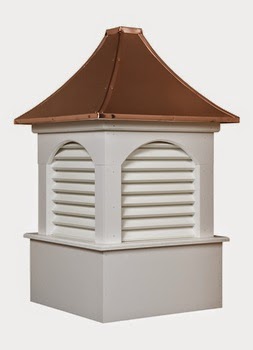
The Carriage House roof is now complete, or at least the slate is on, but it won't be properly finished until the cupola is craned on. The cupola or probably more correctly turret from the latin turris for tower, resembles the one above, and will sit over the gap in the middle of the roofline...
Above and Below: The Carriage House (back and front respectively) with the slate tiles on the roof. Note the gap in the centre of the roofline for the cupola.
The manor was originally going to have a cupola on top, but the chimneys already breached the 10m high 'building envelope' and required us to get a special dispensation. I can not imagine we would have been able to build the cupola (I love NZ dearly, but it does suffer from tall poppy syndrome and many froward people will opposed anything which is different). The cupola for the manor was based on that of Belton House...
However, the small cupola on the Carriage House with its weather vane and clock faces is well within the envelope and has been signed off without any concerns. Originally a cupola on a barn, stable block or carriage house had a practical purpose - the louvres allowed ventilation in what were usually fairly musty buildings full of hay, silage and live animals. Beyond their practical use, they developed more ornate designs, usually incorporating a weather vane and a clock face on one if not all sides, and sometimes a bell...


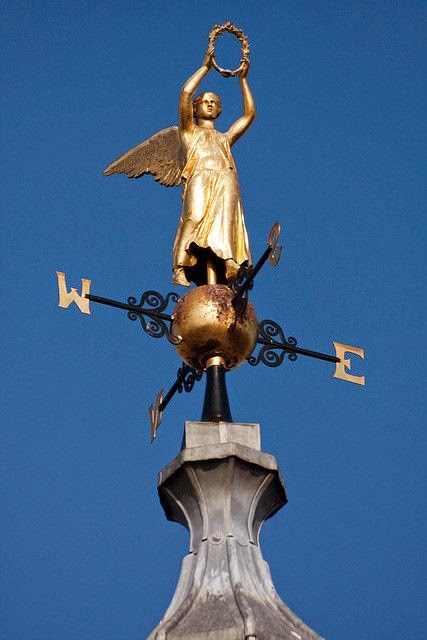
Weather vanes
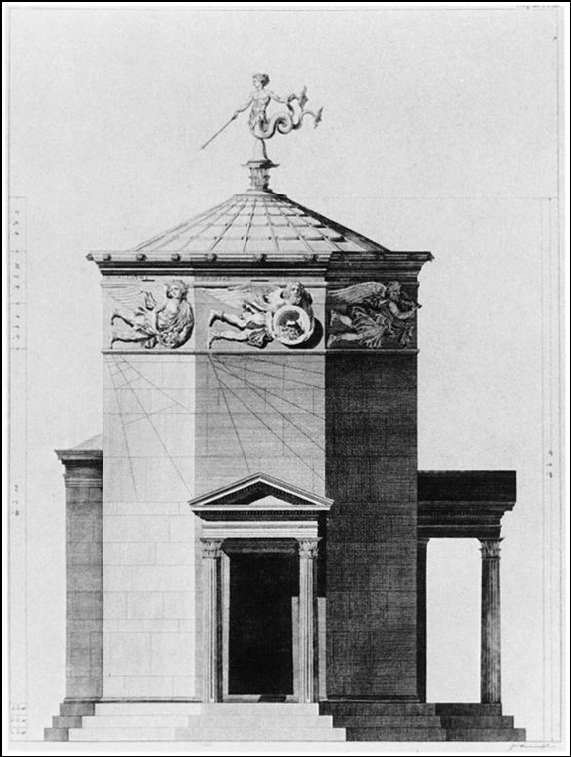
The term weather vane derives from the old English word fana, meaning flag. Weather vanes date back to the ancient Romans and Greeks, a notable example being the weather vane atop the temple of the eight winds in Rome, which comprised the God Neptune with his triton pointing in the direction of the wind flow...
Today weather vanes often take many whimsical forms. Here are some particularly lovely ones...

Above: A traditional trotting horse weather vane
Below: A not so traditional flying pig (I would like to get a flying pig weather vane for the barn).
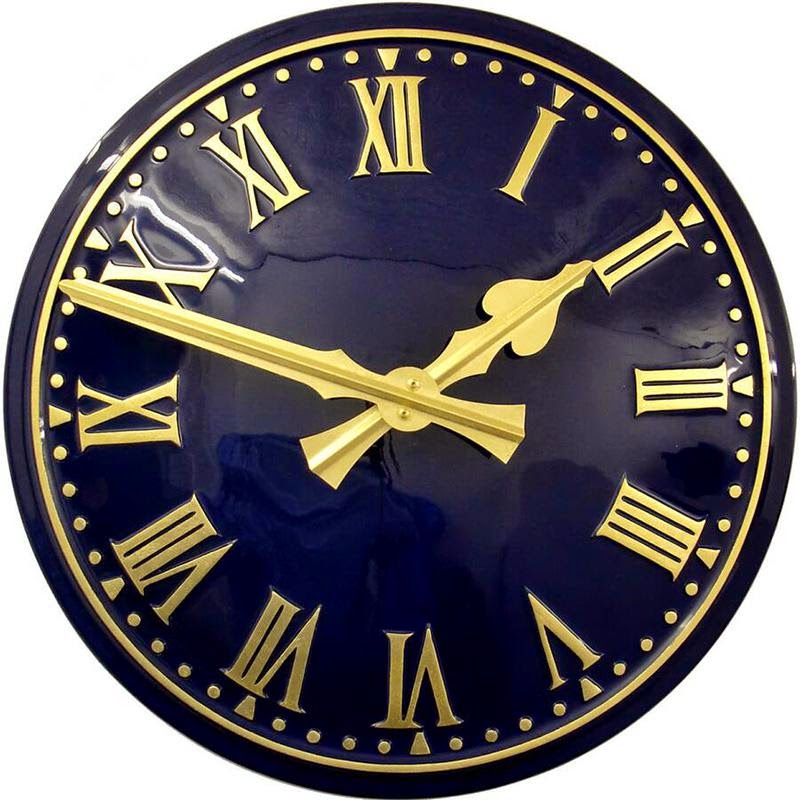
We are pricing up various electric clocks at the moment. I really like this one with a black face and gold numerals, matching the black and gold theme of WBP, from Outdoor Clocks UK...
with maybe an Oxford blue one for the chapel bell tower...
Here are some more of their clocks and turrets...

Labels:
Carriage House,
chapel,
Clock Tower,
Cupola,
Turrets,
Weather Vane
Tuesday, July 10, 2012
Canterbury Tales Part One...
Last week we enjoyed a stunning mini-break catching up with friends down in Canterbury. We had a great time, with plenty of great wine and food. After exploring the international Antarctic centre on Thursday, we mooched around a few antique shops enjoyed a couple of pints at the few pubs which are still standing in Christchurch, and then went home for a dinner of slowly cooked beef chaps with seasonal vegetables and red wine. The next day after a much needed sleep-in we set off on a mystery tour our hosts had arranged.
After some guerilla gardening we were set to go...
We were taken on a lovely scenic tour of southern Canterbury, stopping in historic Oamaru for lunch at a Victorian tea room and visiting the heritage district where all the buildings are of historic importance. Then our journey continued, ending at twilight when we arrived at the small historic vicarage of St Alban's outside Kurow...
It was built in the late 1800s out of hand hewn Oamaru limestone and is situated near the foot hills of the Southern Alps.
"Between 1881 and 1891 the
Anglican community in and around Kurow was served by curates who resided
locally but who were appointed to the vicar of Oamaru. In 1891 this situation
changed, however, when the Waitaki Mission District was established and Hugh Corrie
Frere was appointed as the first curate of the new parish. At the same time
Emily Campbell, wife of the late Robert Campbell who was one of North Otago's
leading landowners, left a large bequest of approximately £5300 to finance the
erection of a church and vicarage in the district.
Emily Campbell's generosity proved to be somewhat
of a mixed blessing, however, as the Anglicans of Duntroon initially disputed
Kurow's suitability as the parish's centre. The New Zealand Church News of
August 1892 records that Mrs Campbell's legacy was causing divisions within the
district's Anglicans although "Kurow (was) really the proper centre of
operations, and ought probably to have both the church and parsonage". [NZ
Church News, Vol XXII, No. 8, p7]. Happily the controversy was eventually
resolved by Bishop Nevill of Dunedin who recommended that a church be erected
at Duntroon whilst a vicarage and adjoining chapel were built at Kurow. £2,500
was subsequently allocated for the construction of the latter, which began
forthwith, although St Martin's Church at Duntroon was not erected until 1901
to a design by Christchurch architect, Thomas Cane.
The large size of the Kurow vicarage may in part
be explained by the fact that the first incumbent at St Alban's had a large
family and a private income with which to pay domestic and stable staff. The
last resident vicar at Kurow vacated the house in 1970."
The vicarage has now been turned into bijoux accommodation, which our hosts had hired for the weekend.
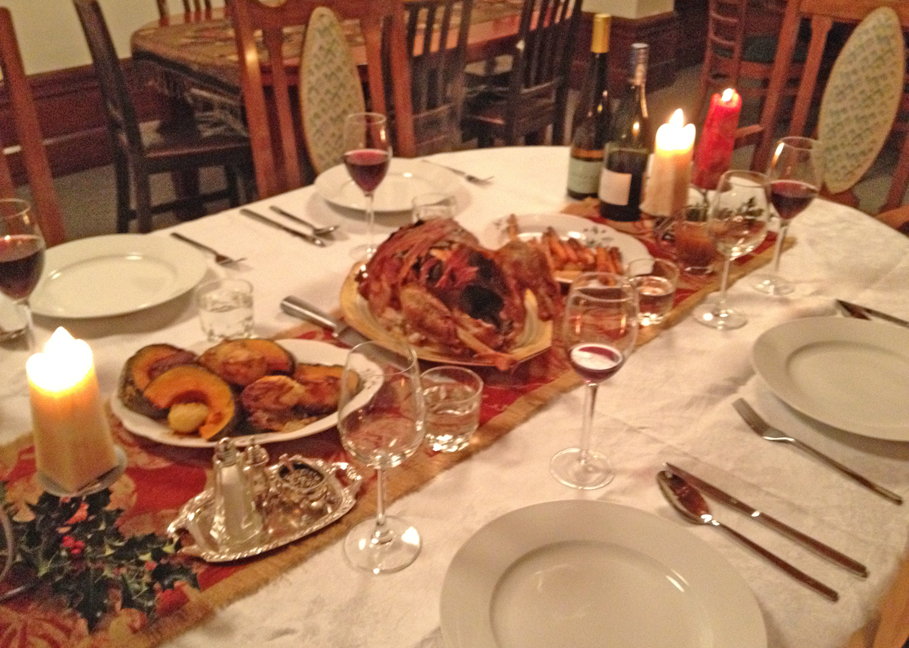
Later the reason for the impromptu holly pruning was revealed, the holly being needed to trim the table for a mid-winter Christmas dinner...
The next day we continued our tour around the lakes of South Canterbury ...
...before returning home by night fall for another lavish spread.
The next day we went to look at a large plot of land they had purchased outside Christchurch, complete with a stream filled with brown trout and wild watercress..
Part 2 Tomorrow...
Labels:
Architecture,
chapel,
Christchurch,
Dinner,
Earthquake,
masonry,
Masonry details,
Private chapel,
Trout
Subscribe to:
Posts (Atom)