Showing posts with label Recipes. Show all posts

Saturday, July 25, 2015

Life In The Sloe Lane...


This week we have six sloe trees arriving to be planted in Badger’s Wood. We have waited patiently for several years to get our hands on some of these. There is only one nursery in NZ which grafts them, and for the last few years there has been a waiting list which outstripped supply due to a poor rate of the grafts taking. However, this year we were top of the list and have secured enough to grow our own little Blackthorn spinney within the woods.

Sloes (Prunus spinosa) are a member of the plum family, which grow wild in many places throughout Europe (and supposedly, according to Wikipedia, many places in New Zealand, although with years of searching we have not been able to find them growing in any of the hedgerows!).

Their common name of Blackthorn derives from the dark bark of the tree, which has large spikey spurs protruding from it. In the spring it blossoms with creamy white flowers which develop into a small highly astringent dark purple berry, known as a sloe. It is similar I guess to a Damson. 


The fruit is used for preserves and for fillings (once combined with an unhealthy amount of sugar to make it palatable); and also for making sloe gin, which is a liqueur made by steeping the sloes in large jars heaped with sugar and then topped with plain gin and left for 6 months.

Traditionally the fruits are picking after the first frost of autumn. The frost allows the fruits to start to bletch a little (although these days one could pick them any time and put them in the freezer to achieve this). I like the tradition of picking them after the first frost, it seems so much more in-tuned with the passing of the seasons and leaves one something to look forward to. 

Once picked, the fruits are then pricked several times piercing the skin. It is traditional to do this with one of the thorns from the bush itself. Once pricked one puts them in a wide necked jar or demijohn and for each pint of sloes (570 mls) one adds 4 Oz (110g) of sugar. The jar is then filled up with gin and left in a cool dark place for a minimum of 3 months, but much better 6 months (as when made sufficiently slowly the liqueur starts to take on a slightly almond-like taste as well, from the berry pips). 

Above photo from London Eats Blog

The sugar is vital not just to humour the bitterness of the berries, but to help draw the flavour out of them into the gin. Turn the jars every day for the first week, and then every week for the remaining time. The gin will take on a lovely deep crimson hue. At the end of this time carefully decant the gin into display bottles and label. Be careful not to discard the sloes as these will now make a nice filling for a pie, perhaps mixed with strewed apple to make them go further, or for creating sloe truffles!


 Sloe Truffles
To make sloe truffles put the left over fruit into a pan and gently simmer until there is minimal liquid left in the mixture and the fruit has softened well. Rub the sloes through a sieve to separate the pulp from the stones. Weigh the pulp, and then add the same weight again in sugar (would make a great treat for the festive season due to both timing of completing the gin and in not caring about what one's waistline does for that month). Simmer again until all the sugar has fully dissolved (one does not want a crystalline filling). Scrape into a jar and leave to set. At this point you can also use this sloe mixture on biscuits with cheese, like quince paste).  To make truffles blend the mixture with an equal amount of dark chocolate (or milk if you prefer), roll into little balls. Allow to set and then dust with cocoa powder and enjoy.

Monday, April 13, 2015

High Tea Survey Results and Recipes...


Well the results are in:

  • There was a lot of support for that last sandwich being egg, so egg it is.
  • Strawberry jam is a must as an option
  • Lots of votes for fruit tarts, esp lemon tarts.

Thank you for all your opinions, which were all considered and informed. They have been a great help. Here as promised are some recipes which I hope you'll try...

Recipe for Scones

This is my fail safe recipe for scones. I first tried it years ago. I was skeptical initially, but they turned out so well and with so little effort that I have never tried another recipe since. The scone mix turns out plain scones, but you can add cheese and herbs to the mix for savoury scones or a pinch of sugar and chopped dates or raisins to make sweet scones.

Ingredients:
3 Cups of self raising flour, sifted.
1 Cup of whole cream.
1 Can of lemonade (Sprite or 7up, not old fashioned lemonade).
A pinch of salt.

Pre-heat a fan forced oven to 180 degrees Celsius (390 F) (200C if not a fan oven)
Combine all ingredients in a bowl and mix until smooth.
Turn out onto a floured surface. Knead lightly and then flatten dough to about 3cm tall.
Cut with a scone cutter and place on a tray covered with a sheet of greased baking parchment.
Bake for 15-20 minutes or until scones are golden brown.
Serve with whipped or clotted cream, and jam.


Recipe for Damson Jam

3 Lb (1.5kg) fresh Damsons
3 Lbs (1.5kg) Sugar
1 Pint (550mls) Water

Wash the damsons and place them in a large saucepan. The stones are hard to remove, so don't bother trying to remove them at the preparation stage, as they will float to the top during the cooking and you can skim them off then.

Ensure you have a decent jam saucepan. The crucial component is a nice thick bottomed pan so that you can ensure the heat is evenly distributed across the pan. Mine is also non-stick (once you have burnt jam once you'll never use a non-stick pan again!).

Add the water and gently simmer. Gentle push on the fruit with a potato masher or similar to help them expel their stones. Skim stones.

Once the mixture has reduced by about half, add the sugar, stirring until fully dissolved. Once fully dissolved bring the mixture to the boil and boil for 10-12 minutes.

Test its ability to set by smearing a small amount on a refrigerated plate and see if it sets. Once it has reached this point remove from the stove and allow to cool. Remove any surface froth with a tea strainer.

Decant into six warm sterilized 1 Lb jars. Cover with wax discs, cellophane, or sterile lids.


Making Clotted Cream

Take several pints of whole cream (unpasteurized or lightly pasteurized (not ultra-pasteurized)). The amount is entirely dependent upon how much clotted cream you want to make. Four pints is probably a good starting amount. Pour it into 1 or 2 shallow dishes - the key here is to find a pan with a large surface area. You want the cream to be poured to a height of about 3-5cm in the dish.

Place the dish in an oven and set to 80 degrees C (180F). Leave for 12 hours - I usually do this about 7pm at night so that it is ready in the morning. 

Remove the now clotted and reduced cream from the oven and allow to cool on a bench for half an hour before placing in the fridge to cool for a further couple of hours (until well chilled).

Skim off the clotted cream from the surface. If it has reduced down a lot you may be lucky enough to have mainly clotted cream and very little liquid cream left.

Put in an airtight jar and keep chilled for up to 3 days. Use on scones, or to make delicious clotted cream fudge. Yum! Any left over liquid cream can be used for making pancakes or for the startup culture for sourdough bread.

Wednesday, April 1, 2015

Feeling Hot Hot Hot...


Today we picked some fresh horseradish from the potager and made home-made horseradish sauce to go with our home grown Hereford steak. 


 It was delicious. Here is the recipe I use..

  • 50g of Grated Horseradish
  • 1 Tsp white wine vinegar
  • Ground rock salt (I prefer pink Himalayan rock salt)
  • Freshly ground pepper
  • 1 Tsp of mustard powder
  • 50-100mls of double cream lightly beaten (or sour cream if you prefer)
  • Squirt of fresh lemon juice if you wish

Clean...

Peel and Chop...

Grate peeled roots then soak in 5 tablespoons of hot water for 10 mins. Drain off the hot water prior to mixing through the other dry ingredients... 

Mix through the cream. The less you use the hotter and firmer the sauce will be. 50-100mls is usually correct for 50g of grated horseradish. Start off with less, you can always add more.

Chill and Serve...

Best if used fresh after chilling in refrigerator. May be kept refrigerated for a couple of days.

Sunday, December 23, 2012

Christmas Mince Pies...


Tis the season to be jolly, and in our family to relax the belt a notch. The religiosity of the feast aside, Christmas day, for us, has always been the time when food is abundant, heavenly sweet and spiced aromas float out of the kitchen, the uplifting mixtures flow freely, and the family banter abounds.

This year we are at sixes and sevens with me packing up to emigrate, with little time to spend preparing elaborate recipes.  We have been invited to a traditional Polish Christmas celebration with friends, which starts on Christmas eve, is punctuated by Midnight Mass, and continues with celebrations well into the early hours. Then we will have our usual extended family luncheon, this year at my grandparents' house; and then a standing Boxing day feast with our Urban Family.

I haven't had to make a Christmas cake this year, as our recent house guests brought us one of their own magnificent home made masterpieces. But, wanting to feel just a little bit creative on the culinary front, I thought my brother and I should turn our hands to making batches of fruit mince pies...


To start off with One will need ingredients for the sweet short pastry, lots of candied peel, 2 apples, dried fruit and spices, and lashings of brandy (I usually use Grand Marnier orange brandy or Chambord framboise).


For the fruit mince finely chop the apples, glace cherries, candied orange and lemon peel, ginger, currants, sultanas, and any other dried fruit you like. Add to a large mixing bowl. Add spices to taste (I use allspice, cinnamon  and nutmeg, with a little mixed spice). Douse liberally with a brandy of your choice. Set aside to imbue.


For the pastry I follow a standard short pastry recipe: 1 cup of plain flour, 75g (2.6oz) of butter, 1/4 cup of fine sugar, 1 egg yolk and a tablespoon of water.

Sift the flour into a bowl and cut in butter until it resembles fine breadcrumb. Stir in sugar, add the egg yolk and the water. Mix into a stiff dough, and then chill for half an hour prior to use. This will make about 400g (4/5 lb) of pastry. One can also add a teaspoon of mixed spice to the ingredients if you wish.

Once chilled, roll your pastry out onto a nice cool surface...


Once it is about 3-4mm thick, use a 7cm cutter to cut as many rounds of pastry as One needs for One's patty pan...


Line your patty pan with the rounds, and prick the pastry well with fork tines, then blind bake in a medium oven for 10 minutes or until lightly baked. (You don't strictly need to blind bake the bottoms, but I find they turn out better and last longer if the bottoms are crisper).


Once the bottoms have been cooked fill the cases with One's fruit mince and cover with more pastry rounds cut with a 6cm cutter. Brushing the edges of the bases with some beaten egg will help the tops to stick to the bottoms, and One can use the left over egg to glaze the tops. 


Bake again in a medium-hot oven (Ca. 180C / 350F) for 15 minutes or until lightly browned. Remove, cool, and dust with icing sugar...


Alternatively you can make a lattice design for the top of the pies or decorate them however you wish. Enjoy with a glass of mulled wine.

Friday, August 3, 2012

Quinces, Jelly, and Dulce de Membrillo...


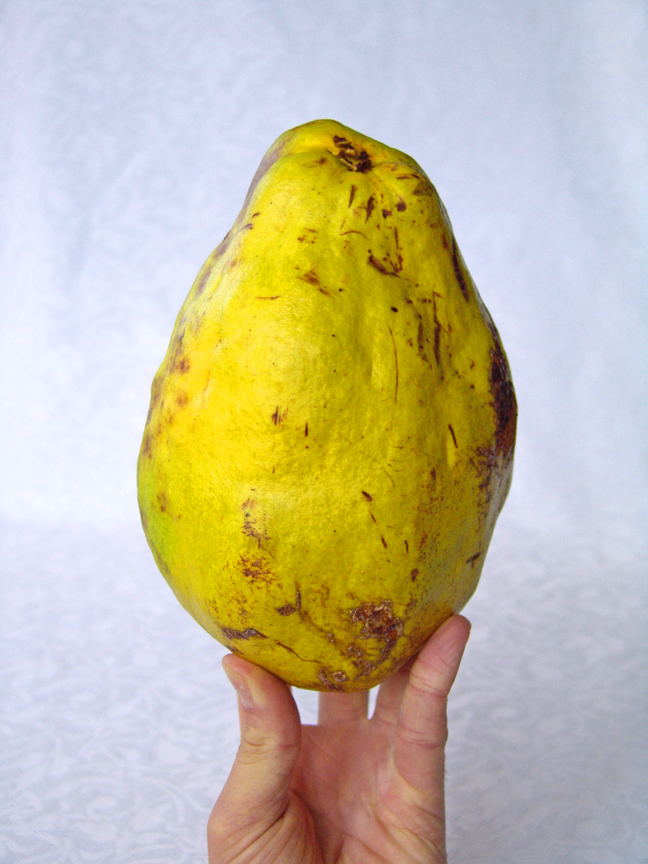
We were recently given a very large bag of Quinces. They were an old fashioned and extremely large variety, as you can see.

Quince is a fruit native to the Mediterranean and the middle east. The tree is a member of the rose family and has stunning blossoms.


Quinces were given by the ancient Greeks as a wedding gifts (as it was the fruit sacred to Aphrodite), and the Romans were fond of stewed quince with honey.


The Portuguese word 'marmalade' originally pertained only to quince jelly, the Portugese word for quince being marmel. In latin american countries the fruit is made into a thick paste, known as Dulce de Membrillo, thicker than quince jelly and cut into thick sweet slices which offset the taste of a decent Stilton or Roquefort perfectly.


So, laden with 100 pounds of giant quinces we set to work.. We followed a friend's recipe...

Scrub the outside of the quinces well, and add the roughly chopped pieces, seeds and all, to a large pot. Add just enough water to stew the fruit until it is soft a pulpy. 
sieve the pulp
If you wish to make quince jelly, instead of sieving the pulp, allow it to drip in a cheesecloth overnight, collecting the clear fluid (don't squeeze the cheesecloth, or you will end up with cloudy jelly). Add sugar to the clear fluid and boil until thick enough to set as jelly.

We tried to make a little of the mixture into jam by adding a little water and lemon juice to part...

for quince paste or Dulce de Membrillo return the seedless pulp to the pan and add sugar pound for pound. Boil whist stirring constantly for at least and hour, until the consistency and colour turn dark and tacky. Leave it to set into thick delicious Membillo...

Add the finishing touches, slice, and enjoy the fruits of your labour...

Monday, May 14, 2012

Sugar and Spice and All Things Nice...


Willowbrook Buns


This revamped recipe is based on an old Chelsea Bun recipe from Peter's Cambridge days. I was reminded of it when we had tea with our godson in Cambridge, and went to Fitzbillies, where the Chelsea buns have been legendary for decades. This is a fun and easy treat for when you need a little sweet carbohydrate pick me up, comfort food, or have been asked to help out with morning tea. 

Combine:
  • 4 cups strong white plain flour
  • 1 cup currants
  • 1/4 cup sugar
  • 60g butter
  • 1 beaten egg
  • 1 teaspoon salt
With
1 generous cup of luke warm milk to which has been added 2 teaspoons dried yeast and 1 teaspoon sugar, and allowed to froth for 10 mins. 

Kneed
the dough and leave to double its size in a warm place (the oven at a bare 50 degrees C is a good place on a cold day) 

Knock
the dough back and then roll out into an oblong 20 x 50cm or thereabouts. 

Sprinkle:
  • 3/4 cup brown sugar
  • 2 teaspoons cinnamon
  • 1 table spoon runny honey
  • 1 table spoon golden syrup
over the dough 

Roll
into a sausage 50 cm long, cut into 5cm slices and place into a baking tray to rise again.

Bake
for 15 mins at 160 degrees Celsius until cooked and golden.

Enjoy!
Related Posts Plugin for WordPress, Blogger...