Unfortunately it is illegal to sell or buy trout in New Zealand, so the only way to taste one is to catch it yourself.
Thursday, August 23, 2012
Boys Camping Trip
After a pretty hectic few weeks, a mate and I decided we should go on a boys' fishing trip.
I drove down to a small rural hospital on Tuesday and did a locum shift there, and then my friend met me there in the evening and we set off to commune with nature. We headed off to a small spot on the banks of the Whanganui river, about 30 minutes out of Taumaranui, which the local fishing store owner had recommended.
We found a good spot near the river to pitch our tents. I had borrowed a tent from a camping friend, which did not come with instructions and didn't at all resemble the traditional tent shape that I was used to as a boy scout. Erecting it was like the Krypton factor, but after wrestling with it in the dark for half an hour it resembled something inhabitable...
After getting our bearings we hunkered down for a slap up meal on the camp fire and a bottle of scotch. The evening passed quickly and soon we hit the hay. I slept well, but my friend awoke during the night to find that our camp was being rummaged through by some marauding wild goats!
Above: We later found the pack of wild goats across the river, half way up a hill...
It was a cold night, getting down to a couple of degrees below zero, but the tents were surprisingly warm, which made outside rather bracing for breakfast.
Above: The early morning fog over the valley
Below: Getting up in the morning
Below: One of the many frosty-morning cobwebs..
We then set off for an early start fishing. It soon fined up into a lovely day for it...
Above: Wading out into the middle of the river
Below: The view up the river from the middle
I tried several flies: assorted nymphs, various variations on a Wooly Bugger, and some glow bugs...
Alas, we didn't get so much as a bite. So by lunch we headed back to camp and scoffed some bacon butties for lunch (I'm not much of a Bear Grylls when it comes to food, so it was lucky we packed a little F&M styled hamper for the eventuality that we didn't catch anything.
Unfortunately it is illegal to sell or buy trout in New Zealand, so the only way to taste one is to catch it yourself.
In the afternoon we packed up camp and headed down to National Park to another supposedly good fishing spot there, but again no luck. We packed up and came home empty handed, but it was good to get away from it all for a day or two.
Labels:
Camping,
Countryside,
Fishing,
hunting,
Whanganui River
Tuesday, August 14, 2012
Morning Moon Over Farm
Yesterday I got up early to check on the stock and let the goats out of their shelter. It was about 6 am, and still pitch black, but there was a lovely moon...
It has been tipping down lately, and I can't wait til Spring arrives, and with it daylight savings time. It's horrid getting up and going to work in the dark then coming home, again in the dark. And to top it all off I've been down with a horrid chest infection. Never mind, soon We should be up and on top of things again with some new posts and some more pics of the landscaping progress.
Labels:
Moon,
Willowbrook Park,
Winter
Friday, August 10, 2012
Taking the bull by the horns...
I wanted to surprise Peter for his birthday with something unique. I decided to make him a pair of book ends using Bella's horns. I got several pieces of pine mouldings and glued them together, then cut them to length and stained and varnished them. I then cleaned and sanded the horns and varnished them before mounting them on the wooden mouldings...
Labels:
Edward and Bella,
horn,
Peter Lord Cowell,
Study,
Taxidermy
Tuesday, August 7, 2012
Pig Hilton Mark 2...
After 2 years of breeding Wessex Saddlebacks, we were in need of a larger pig sty. Pig 'Hilton' mark one was a rectangular ark made of plywood, open at one end - functional but not pretty. I did some research into traditional pig stys, ones that would look at home on an English-styled farm. There were several which caught my attention...
Above: A Traditional Welsh Pig Sty
I like the look of the old traditional pig stys, but they are impractical, non-transportable, and designed for non free-range pigs.
Having seen some of the shelters on the market...
And some old stone huts...
...I struck upon the idea of making a stone-look sty out of wood. So, my grandfather and I set about building Pig Hilton mark 2 - out of completely recycled materials.
We had some timber from previous projects lying around, and we pulled the plywood lining off the inside of the current barn (knowing that it is going to be demolished to make way for the driveway next year). One of our neighbours gave us a whole lot of spare roofing iron, and so we were set to start building.
Above: Old Timber which we used to create the floor (below)
The floor size was 7'x10'.
Above: Putting the framing for the walls up
Below: Starting to make the trusses for the roof
The finished roof framing
Below: Cutting the roofing iron
Putting on the roof...
All the way through my grandfather taught me heaps of helpful hints and tips that I will be able to apply to any other buildings in the future.
Almost completed project - structurally finished with gate latched back against wall. Now we just need to find some stone coloured paint and set about adding the finishing touches.
Below: The old pig sty, with the brook swollen with water due to all the rain we have had.
I'll post an update once we've painted it. Now I've learnt how to build a gabled animal shelter, my next project is going to be a potting shed for the middle of the potager garden.
Friday, August 3, 2012
Quinces, Jelly, and Dulce de Membrillo...
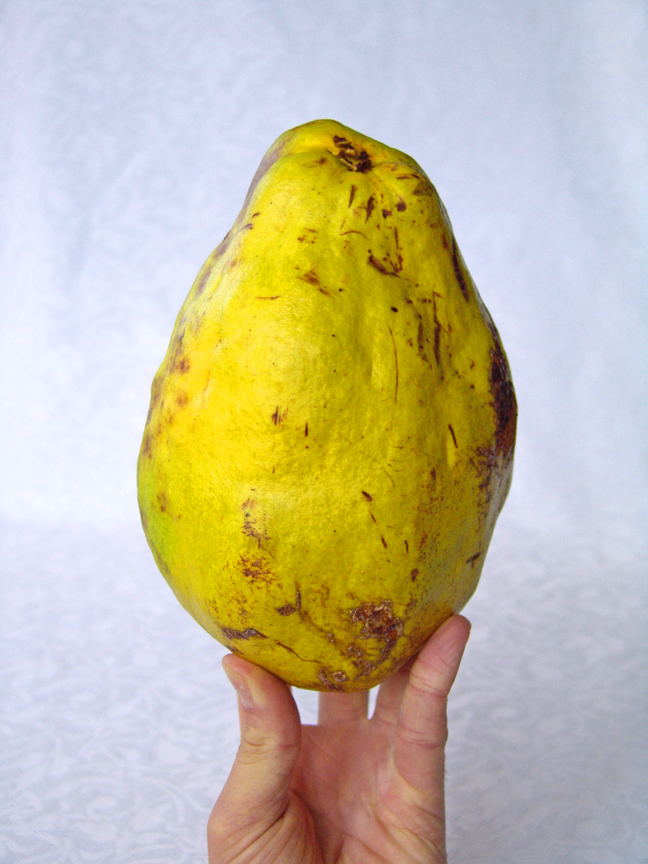
We were recently given a very large bag of Quinces. They were an old fashioned and extremely large variety, as you can see.
Quince is a fruit native to the Mediterranean and the middle east. The tree is a member of the rose family and has stunning blossoms.
Quinces were given by the ancient Greeks as a wedding gifts (as it was the fruit sacred to Aphrodite), and the Romans were fond of stewed quince with honey.
The Portuguese word 'marmalade' originally pertained only to quince jelly, the Portugese word for quince being marmel. In latin american countries the fruit is made into a thick paste, known as Dulce de Membrillo, thicker than quince jelly and cut into thick sweet slices which offset the taste of a decent Stilton or Roquefort perfectly.
So, laden with 100 pounds of giant quinces we set to work.. We followed a friend's recipe...
Scrub the outside of the quinces well, and add the roughly chopped pieces, seeds and all, to a large pot. Add just enough water to stew the fruit until it is soft a pulpy.
sieve the pulp
If you wish to make quince jelly, instead of sieving the pulp, allow it to drip in a cheesecloth overnight, collecting the clear fluid (don't squeeze the cheesecloth, or you will end up with cloudy jelly). Add sugar to the clear fluid and boil until thick enough to set as jelly.
We tried to make a little of the mixture into jam by adding a little water and lemon juice to part...
for quince paste or Dulce de Membrillo return the seedless pulp to the pan and add sugar pound for pound. Boil whist stirring constantly for at least and hour, until the consistency and colour turn dark and tacky. Leave it to set into thick delicious Membillo...
Add the finishing touches, slice, and enjoy the fruits of your labour...
Labels:
Dulce de Membrillo,
Jam,
orchard,
Paste,
Preserves,
Quince,
Recipes,
Willowbrook Park Cookbook
Subscribe to:
Posts (Atom)