Showing posts with label Highland Cattle. Show all posts
Wednesday, August 19, 2015
Little Orphan Alex...
Peter and I are currently enjoying life in the slow lane, having taken our annual hols. We are visiting family in Denver before flying on to London later this week to catch up with friends and urban family there.
Before Peter left there was one small tragedy on the farm - one of the highland cows died during child birth, leaving behind a little bull calf one cold and wet night. Peter named him Alexander, and thanks to the help of our friend Sue, he is doing really well. Peter collected some colostrum from my uncle and set up a feeding system with a tank and a teat. After some coaching Alex got the hang off feeding from it.
The first night he was born was the most touch and go, but getting the colostrum into him and getting him in to a warm shelter saved the day...
Then we transferred him down the road to our friend Sue, who has been caring for him...
Now he is doing well and integrating with our highland calves from last year, who also live down the road, coincidentally next door to Sue...
They have been making him feel welcome...
I'll leave you with these short clips of Alex. When we get back from our hols there will be plenty of news to share, and some more progress photos as the builders are steaming ahead with all the interior marble now.
Labels:
Alexander,
Calves,
Highland Cattle
Wednesday, July 30, 2014
Down on the farm...
It has been a while since we posted anything about the animals down on the farm. They are still multiplying and doing their thing. Since Edward and Bella we are on our 3rd pair of Hereford calves (all the others having gone on holiday to a cooler clime). Peter has our latest ones wrapped around his little finger - literally...
We are also on our second calving of Highland Cattle since we bought the herd. The bull is good at doing his thing and the calves are all very healthy. You can see how we are strip grazing them (below) to ensure we manage the pasture well over the wetter winter months. There is still plenty of hay should we run out of grass.

The Dorset Horns are doing very well. They now regularly lamb twice a year, which means that we may get as many as four lambs per ewe each year. Here they are frolicking about...
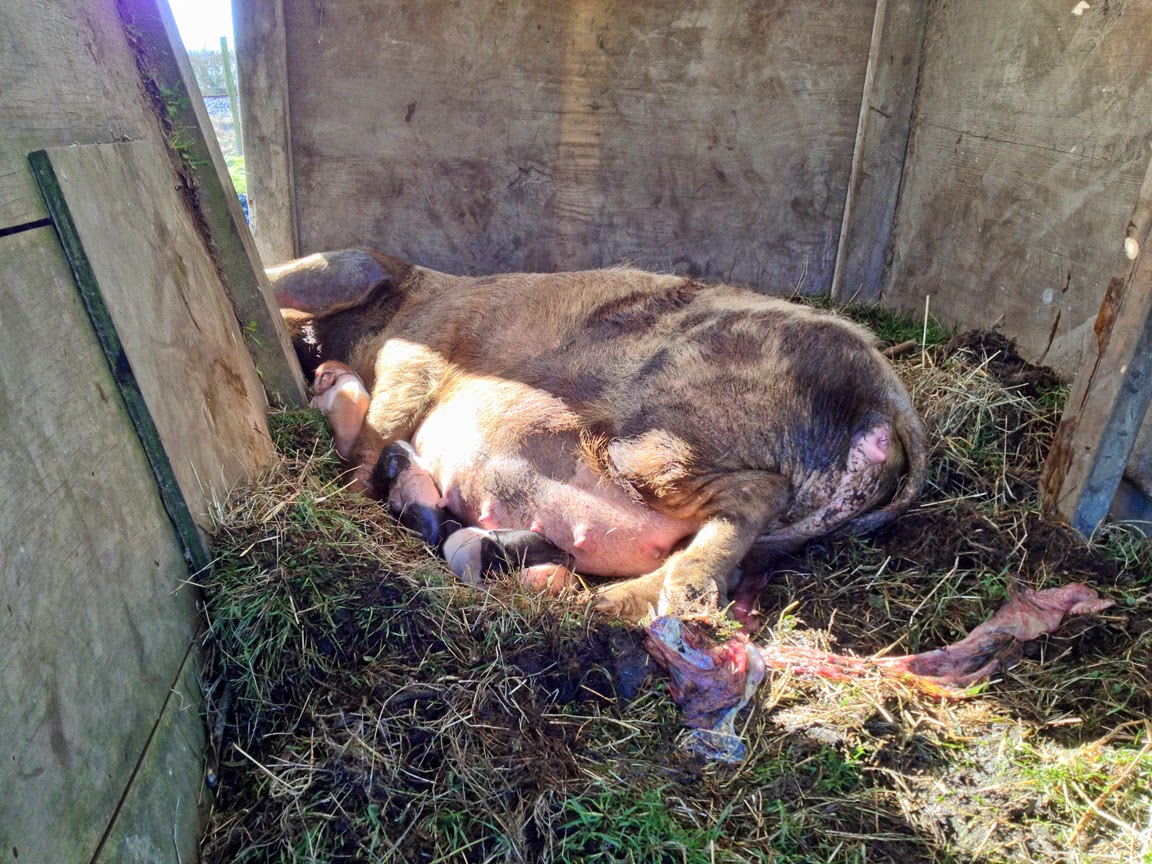
And the pigs are doing well well. We have 3 sows and 1 boar (who is regularly 'pimped' out to other farms). I managed to catch Caramel, one of our Ginger Saddlebacks, giving birth the other morning. Here are some pictures and some videos (videos not for the faint-hearted)...
Above: Caramel resting in the sun after her efforts.
Below: The rooster 'Madison' would not leave her throughout the whole event.
Labels:
Calf,
Hereford,
Highland Cattle,
Piglets,
pond,
Wessex Saddlebacks
Wednesday, April 3, 2013
Kenneth, Our Highland Bull has Arrived...
We have successfully stuck to our plan and sold three of our Highland calves, and used the proceeds to purchase a pedigree bull to service our remaining 3 pedigree cows. We have named him Kenneth in memory of a dear friend no longer with us, who always took a keen interest in Willowbrook and the Rare Breeds Farm.
He is a lovely tame creature, who although only at WBP for 3 days, has settled into the Highland fold already.
My cousin James is looking after him and all the other animals on the farm for the next week as Peter is coming over to join me for a holiday. In fact, he is due to touch down any minute at the airport, so I'm off to collect him.
Labels:
Cows,
Highland Cattle,
Rare Breeds Farm
Thursday, January 31, 2013
The Dubbo Chronicles No.2
Well, it will be three weeks tomorrow since I arrived in Dubbo and time passes quickly when one is finding one's feet.
The homesickness pangs have started to sneak in now and then. Foolish things, like waking up in the morning and turning over to find that there is no cup of coffee waiting for you on the bedside table, or dropping one's toast on the floor and calling for the dog, only to realise he's not there.
People have continued to be friendly and all my colleagues are lovely people. The work is varied and exciting. I have seen my first snake bites and spider bites (and coming from a country that has no poisonous animals it seems quite exciting). There seems to be a real need in the area, and it is the last major hospital before you hit the large nothing to the west.
Life at Willowbrook is ticking on. I hear that we have bought a new tractor and lawnmower; that our head gardener and farm manager has everything under control.
We had the final Highland calf born - a boy, and have sold 4 of the other calves, which means that we can now buy a bull for the fold. Peter has sourced a lovely much handled 5 year old pedigree bull, called McIntyre...
He should arrive in March, just in time to do the business.
Well, that's all for now. I am enjoying keeping up with everyone's blogs now that after 3 weeks I finally have broadband - Yay. It is just about time for another installment of the Great Estates Series, so I shall get onto that for this weekend.
Till then I'll leave you with this charming song I came across: These foolish things (remind me of you)...
Labels:
Dubbo,
Highland Cattle
Monday, October 15, 2012
Weather Bomb...
A nasty weather bomb descended across the north island yesterday, and upon Willowbrook. One of our 3 year old Plane trees was snapped in half and many of our new trees blown over. It was difficult driving home with the twigs and leaves and rain hitting the windows. We fared better than some parts of the island, where roofs were ripped off and windows blown in. Just a little way down our road several mature trees were uprooted or torn apart by the winds...
Despite the bad weather, our second Highland Cow decided it was time to give birth. Here are some pictures taken in the calm after the storm...
Even the Herefords were nosey...
At least The Bluebell Walk has managed to survive to buffeting winds (so far)...
Labels:
Bluebell Walk,
Calf,
Highland Cattle,
Storm,
Weather
Thursday, September 27, 2012
Baby Baby Baby...
We are thrilled that our first highland calf has been born, and it is a boy - Douglas.
True to Willowbrook form, cow #1 gave birth first. Two more to go.
She chose a good break in the weather to give birth too.
Labels:
Calf,
Calves,
Calving,
Cow,
Highland Cattle,
Rare Breeds Farm,
Scotland
Wednesday, July 18, 2012
Our Hairy Coos Have Arrived...
Our Highland Cattle arrived after work today. Light was fading quickly on a mid-winter's day, but still managed to get a few pics. Now we just have to think of nine Scottish names. Any suggestions...
Saturday, June 16, 2012
The Willowbrook Highland Cattle Fold...
We have finally settled on the type of cattle we are going to breed at Willowbrook. It was a close competition between Highland Cattle and Belted Galloways, but in the end the large horns and the extra long shaggy coats of the Highlands tipped them into pole position. This will bring to a close our stocking of the rare breeds farm, as we will then be at full capacity and will have only rare breeds on site, having sold on our Herefords.
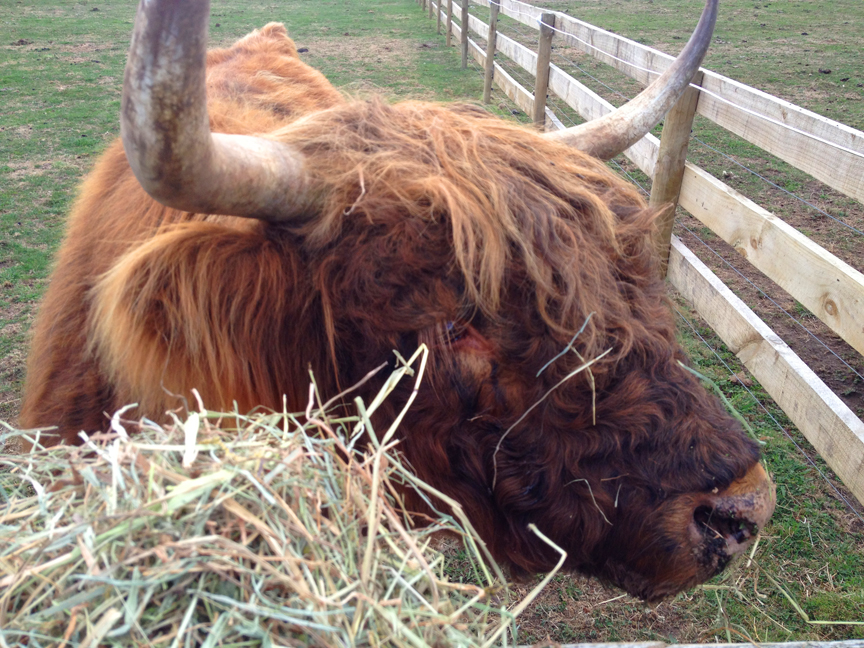
Highland cattle or kyloe are a Scottish breed of beef cattle with long horns and long wavy coats. The can be coloured black, brindled (red and brown tiger striping), red, yellow or dun (a warm nut-brown). We are getting three pregnant dun coloured cows, and shall get a bull next year to run with them. If we get a yellow bull we should end up with a mixture of duns and yellows. The yellow colour is more of a warm caramel - see below...
The breed was developed in the Scottish Highlands and Western Isles. The breed was developed from two sets of stock,one originally black, and the other reddish. Breeding stock have been exported to the rest of the world, and once an 'extremely rare' breed, they are now only considered 'rare'.
Highlands are known as a hardy breed due to the rugged nature of their native Scottish Highlands, with high rainfall and strong winds.Highland cattle have been successfully established in many temperate countries and indeed in countries where winters are substantially colder than Scotland's such as central Europe and Canada. Their hair provides protection during the cold winters and their skill in browsing for food enables them to survive in steep mountain areas. They both graze and browse and eat plants which many other cattle avoid. The meat tends to be leaner than most beef because Highlands get most of their insulation from their thick shaggy hair rather than subcutaneous fat. The coat makes them a good breed for cold northern climates and they are able to thrive in outdoor conditions that would defeat most other breeds of domestic beef cattle. As such, Highland cattle are able to produce beef at a reasonable gross margin from inhospitable land that would otherwise normally be incapable of rendering a profit agriculturally.Whilst the UK domestic and worldwide popularity of Highland cattle has made trade in pedigree beasts occasionally the most lucrative - mainly on account of their handsome appearance - they are at their best agriculturally when used to produce beef in a cold climate from poor pasture and forage.
Whilst the beef produced by pure-bred Highland cattle is exceptionally tender and of high flavour, modern butchery and shopping trends tend to demand a carcass and a cut of meat of a different character. In order to address this market, Highland beef producers commonly run commercial Highland suckler cows with a 'terminal' sire such as a Shorthorn or Limousin bull. This allows the hardy Highland cow, grazed upon the rough hillsides of her natural environment, to produce across-bred beef calf featuring the tender beef of its mother on a more modern carcass of high commercial value at slaughter, thus rendering a gross margin from her grazing that would have been impossible from other breeds in that environment. There is also a healthy demand from fellow producers of outdoor-reared beef who farm on more forgiving terrain, for Highland cross-bred bulling heifers: most often Highland cows crossed with the Shorthorn bull, for use as suckler cows. These cross-bred beef suckler cows inherit the hardiness,thrift and mothering capabilities of their Highland dams and the improved carcass configuration or their sires. Such cross-bred sucklers, further crossed with a modern beef bull such as a Limousin or Charolaisto produce the finest quality beef are one of the mainstays of Scottish commercial beef production. It is this ability to pass on thrift and gross margin down the beef-breeding cascade that has secured this breed's place as a modern commercial beef breed.
There are many international societies for Highland cattle. The British Highland Cattle Society, whose patron is Her Majesty, The Queen, is a registered charity. There are at least two Highland Societies in New Zealand. We shall join the New Zealand Highland Cattle Society.
The hairy calves are adorable...
Below: A prize Highland at Dumfries House...
Subscribe to:
Posts (Atom)