A Tribute to the 1st day of Summer featuring the works of Henry Scott Tuke and Thomas Eakins


Henry Scott Tuke was born in York in to a Quaker dynasty in 1858, and went to live in Falmouth, Cornwall, in 1860. The happy memories of Tuke’s childhood spent on the beaches around Falmouth, watching the tall ships coming into the harbour from all over the world, helped his decision 23 years later to return to live firstly in Newlyn then in Falmouth where he remained for the rest of his life.

Above: "3 Companions"
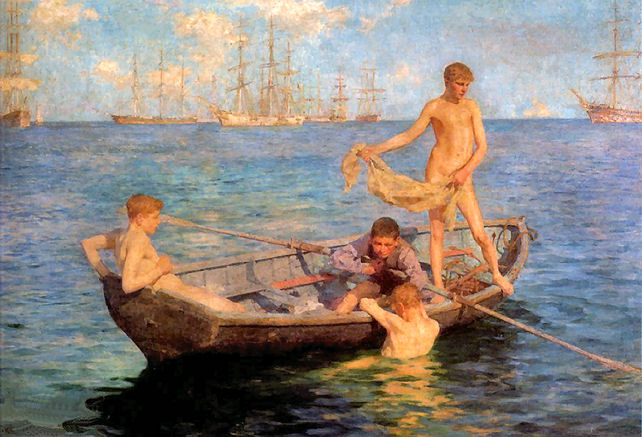
In his early paintings, Tuke placed his male nudes in mythological contexts, but the critics found these works to be rather formal, lifeless and flaccid. From the 1890s, Tuke abandoned mythological themes and began to paint local boys fishing, sailing, swimming and diving, and also began to paint in a more naturalistic style. His handling of paint became freer, and he began using bold, fresh colour. One of his best known paintings from this period is August Blue. Looe artist, Lindsay Symington (1872–1942), modelled for the blonde boy holding onto the boat in the water; though not a regular model, Symington was a good friend of Tuke, the latter often visiting the Symington family home, Pixies' Holt, at Dartmeet. Tuke painted some female nudes but these were not as successful as his male nude paintings.
Below: "The Lighthouse"

Best known for his paintings of bathing boys, Henry Scott Tuke was in fact, a very diverse and talented artist in a variety of subjects and media. His first commissions were portraits of family and friends, including other Quakers such as the Fox family. Tuke was also known as great maritime artist, a very accurate depicter of every kind of sailing craft from Lowestoft fishing boats that came to Falmouth in the winter, to wooden and steel hulled sailing ships such as barques and brigantines, to smaller quay punts and yawls.

Above: "

Ruby, gold and malachite", 1902.
Below: "August Blue", 1893.

Initially, Tuke returned to Newlyn after the tragically early death of his only brother William Tuke in 1883 from TB, to paint alongside his fellow ex-students from the Slade School of Fine Art in London and the Ateliers of Paris. Most of his paintings from Newlyn are quite dark interiors set in Philip Harvey’s fishing tackle cellar in Trewarveneth Street, where Tuke rented rooms. His subjects were the local children such as Ambrose Rouffignac posing with a model boat or eating his dinner. Newlyn was where Tuke started to get a taste for all things nautical. He bought his first boat The Ripple, there, and he did his first painting of boys sitting in a small rowing boat on a sunny day in Newlyn harbour. But it was Falmouth that won his heart in the end, and he moved into rented rooms at Pennance Cottage at Pennance point near Swanpool in 1885.
Below: "The Bathers"

Below: "The Bather", 1924.
.jpg)
The beaches were an ideal setting as they were south facing, usually bathed in sunshine and had interesting barnacle encrusted rocks and shallow warm pools for the models to stand around. Tuke has started painting the nude figure whilst studying at the Slade in London where he won prizes for his life painting. But it was in Italy that he first painted male youths outdoors in 1881.
 Although Tuke's paintings of nude youths undoubtedly appealed to his gay friends and art-buyers, they are never explicitly sexual. The models' genitals are almost never shown, they are almost never in physical contact with each other, and there is never any suggestion of overt sexuality. Most of the paintings have the nude models standing or crouching on the beach facing out to sea, so only the back view is displayed.
Below: "Youth in White Trousers"

Below: "Noonday Heat", 1911.

Below: "The Sun Worshipper", 1904.

Below: "Boy on the Beach".
 After an inspirational trip some 11 years later in 1892 to the Mediterranean and the Greek island of Corfu, he came back wanting to paint the nude outdoors in Falmouth. He had attempted painting nude bathers as early as 1885 with a professional male model brought from London, but soon found this expensive and difficult. This was equally true when trying to obtain female models. In the end, Tuke asked the local lads to pose nude for him. Tuke always paid them and treated them with courtesy and consideration, although he demanded they were professional and sometimes asked them to model outdoors as late as November.
 Pennance cottage was also, it seems, chosen by Tuke because if its proximity to some secluded and fairly inaccessible beaches such as Newporth beach. These beaches were vital to the subject that he created as his greatest artistic challenge, painting the nude human figure outdoors.
From 1900 to 1914 he was at the height of his powers as a painter and experimented with impressionist techniques. This can be seen in his stunning figure composition Midsummer Morning, 1908.
Below: "Midsummer Morning", 1908.


Below: "A Bathing Group" ? 1904.

Below: "Under the western sun", 1917.

His first great success in his bathing boy paintings was ‘August Blue’ 1894 Tate Gallery. Having been bought for the nation it heralded Tuke’s arrival as an important artist of the late Victorian era. Tuke favoured rough, visible brush strokes, at a time when a smooth, polished finish was favoured by fashionable painters and critics. He had a strong sense of colour and excelled in the depiction of natural light, particularly the soft, fragile sunlight of the English summer. Although Tuke often finished paintings in the studio, photographic evidence shows that he worked mainly in the open air, which accounts for their freshness of colour and the realistic effects of sunlight reflected by the sea and on the naked flesh of his models.
Below: "Boy in the Cove"

Above: A modern painting after Tuke.
Major examples of his male nudes were purchased by major art galleries including The Bathers at Leeds Art Gallery and August Blue at the Tate in London. But he was also well known as a portraitist, and maintained a London studio to work on his commissions. Among his best known portraits is that of soldier and writer T.E. Lawrence ("Lawrence of Arabia").

Above: A Portrait of Johnny Jackett
Below: Portrait of a young man

Below: Self Portrait 1920.

Tuke enjoyed a considerable reputation, and he earned enough money from his paintings to enable him to travel abroad and he painted in France, Italy and the West Indies. In 1900 a banquet was held in his honour at the Royal Cornwall Polytechnic Society. He was elected to the Royal Academy of Arts in 1914 and a Royal Academician in 1914.Works by Henry Scott Tuke are in public art collections across the world including at Sydney, Adelaide and Brisbane in Australia, Auckland and Wellington in New Zealand and Munich, Germany as well as throughout the UK and Ireland.
Thomas Cowperthwait Eakins (July 25, 1844 – June 25, 1916) was an American realist painter, photographer and sculptor. He is widely acknowledged to be one of the most important artists in American art history.

Above: Eakins
Below: A Self-Portrait


The Swimming Hole (above) (1884-5) features Eakins' finest studies of the nude, in his most successfully constructed outdoor picture. The figures are those of his friends and students, and include a self-portrait. The work was painted on commission, but was refused.

Above: "Arcadia" Ca. 1883
Below: "An Arcadian" Ca. 1883

Eakins produced a number of large paintings which brought the portrait out of the drawing room and into the offices, streets, parks, rivers, arenas, and surgical amphitheaters of his city. These active outdoor venues allowed him to paint the subject which most inspired him: the nude or lightly clad figure in motion. In the process he could model the forms of the body in full sunlight, and create images of deep space utilizing his studies in perspective.
For the length of his professional career, from the early 1870s until his health began to fail some forty years later, Eakins worked exactingly from life, choosing as his subject the people of his hometown of Philidelphia. He painted several hundred portraits, usually of friends, family members, or prominent people in the arts, sciences, medicine, and clergy. Taken en masse, the portraits offer an overview of the intellectual life of Philadelphia in the late 19th and early 20th centuries; individually, they are incisive depictions of thinking persons.
In the late 1890s Eakins returned to the male figure, this time in a more urban setting. Taking the Count (1896), a painting of a prizefight, was his second largest canvas, but not his most successful composition.
In his later years Eakins persistently asked his female portrait models to pose in the nude, a practice which would have been all but prohibited in conventional Philadelphia society. Inevitably, his desires were frustrated.


 Above: "3 Companions"


.jpg)
 Although Tuke's paintings of nude youths undoubtedly appealed to his gay friends and art-buyers, they are never explicitly sexual. The models' genitals are almost never shown, they are almost never in physical contact with each other, and there is never any suggestion of overt sexuality. Most of the paintings have the nude models standing or crouching on the beach facing out to sea, so only the back view is displayed.


 After an inspirational trip some 11 years later in 1892 to the Mediterranean and the Greek island of Corfu, he came back wanting to paint the nude outdoors in Falmouth. He had attempted painting nude bathers as early as 1885 with a professional male model brought from London, but soon found this expensive and difficult. This was equally true when trying to obtain female models. In the end, Tuke asked the local lads to pose nude for him. Tuke always paid them and treated them with courtesy and consideration, although he demanded they were professional and sometimes asked them to model outdoors as late as November.


 Above: A modern painting after Tuke.