Monday, November 29, 2010

The Boys' Weekend...

Well, I finally took a weekend off work, my first in 6 months, and went on an overnight tramp with some mates...

We started off from Hamilton in the early hours and spent the morning fishing in the Tongariro River, which is famous for its trout...


Despite seeing quite a few fish in the river, we didn't catch a thing. - but then it was midday. Not having time to stay for a twilight fish we carried on south towards Tongariro, parked up, and set out on the Urchin Trail up over the Kaimanawa Ranges.

Dominated by the Kaimanawa mountain ranges, the Kaimanawa Forest Park encompasses a vast (77,348 hectares) largely unmodified expanse of native forest, shrublands and tussock grasslands. It was gazetted in 1969 and is managed to protect and conserve soil and water, native vegetation, wildlife and scenic values.

It lies south-east of Taupo and extends from Tongariro National Park in the west to the Kaweka Ranges in the east.

It was a blisteringly hot day.

Below: Lake Taupo in the distance, from the first summit.
The trail starts near to lake level.


It then winds its way up through stunning native bush...


before breaking out of the bushline into rocky alpine terrain...


from the first summit we hiked over the ranges below...


to the Waipakihi Valley river flats below...


After a long day's tramping, and a futile effort at stalking deer on the river flats, we settled down to a roaring camp fire and a rough meal of Fillet Mignon with seasonal vegetables and a bottle of Shiraz before scoffing down some creme brulee and settling in for a night of port and cigars under a cloudless sky enblazoned with stars (talk about slumming it!).


We forgot the marshmellows though!


The state forest is home to much wildlife, including Sika deer


and wild horses, known as Kaimanawa horses, which are protected.


for more information visit the Department of Conservation website.

Thursday, November 18, 2010

Cows and Cattle...

We collected some more Hereford calves last weekend. My uncle had been rearing them for us on his farm in Te Pahu.

Introducing Bertha, Daisy, Doris and Mavis...


Above and Below: Edward shows interest in the newcomers.


One day they would grow up to look like these beasts below, except that Edward and Bella will be going on a very very long holiday next April.


For more information visit the official English Hereford site: http://www.herefordcattle.org/index.php. I love Herefords Alas, many of the other traditional breeds of cows and cattle have gone by the by over the last century due to their lack of suitability for commercial farming...


I love the cow prints above, posted at Brabourne Farm.

Here are some individual prints of different varieties...


Tuesday, November 16, 2010

Everything's a box of fluffy ducks...

Apologies for the silent treatment of late. Work has been all consuming, and so has the business side of getting the build started (still on target for next month). We have been busy boxing up the house, redressing the rooms, and getting the gardens in order before we put our villa on the market. However, I do have one small piece of breaking news...

You may recall our post on Indian Runners a little while ago. We were expecting we would re-home some adult ducks, but instead we have come into five of the cutest ducklings...


We have constructed a brutally functional Stalag 13 for the ducklings at the park until they get their bearings, but then they will be on their way, free-ranging with the rest of the menagerie.

Saturday, October 23, 2010

Anglesea Abbey and Espalier...

Peter is back in the UK again for 3 weeks, and has been emailing back plenty of lovely photographs as he gallivants about the countryside. Yesterday he went to visit an old haunt, Anglesea Abbey, where he used to spend time studying in the gardens when he was at Cambridge University. He is enjoying lovely weather, as you can see...


Anglesea Abbey (above) is a former priory in the village of Lode, 5 ½ miles northeast of Cambridge. A community of Augustinian Canons during the reign of Henry I (1100 and 1135), built their priory there, and later acquired extra land from the nearby village of Bottisham to create their gardens. The canons were expelled in 1535 during the Dissolution of the Monasteries.

The former priory was acquired around 1600 by Thomas Hobson, who converted it to a country house for his son-in-law, Thomas Parker, retaining a few arches from the original priory. At that time the building's name was changed to "Anglesey Abbey", which sounded grander than the original "Anglesey Priory".

In the late 18th century, the house was owned by Sir George Downing, the founder of Downing College, Cambridge.

Huttleston (1896–1966) and Henry (1900–1973) Broughton bought the site in 1926 and made improvements to the house. They were the sons of Urban Broughton (1857–1929), who had made a fortune in the mining and railway industries in America. Henry married, leaving the abbey to his brother, then 1st Lord Fairhaven, in 1930.

Henry became the 2nd Lord Fairhaven. Huttleston used his wealth to indulge his interests in history, art, and garden design, and to lead an eighteenth-century lifestyle at the house. On his death, Huttleston left the abbey to the National Trust so that the house and gardens could "represent an age and way of life that was quickly passing"

The house and grounds are open to the public (although some parts remain the private home of the Fairhaven family). The 98 acres (400,000 m²) of landscaped grounds are divided into a number of walks and gardens, with classical statuary, topiary and flowerbeds.


The grounds were laid out in an 18th-century style by the estate's last private owner, the first Baron Fairhaven, in the 1930s. A large pool, the Quarry Pool, is believed to be the site of a prehistoric coprolite mine. Lode Water Mill, dating from the 18th century was restored to working condition in 1982 and now sells flour to visitors.

Below: The bench where Peter used to study


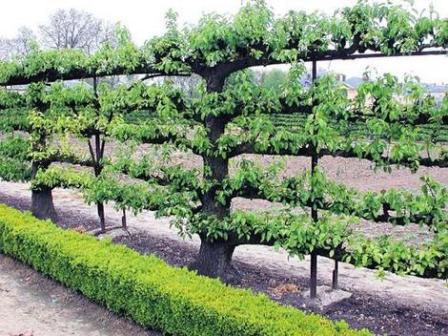
Below: A large espaliered tree at the abbey...


The French word espalier (from the Italian spalliera, meaning “something to rest the shoulder (spalla) against”), describes the art of training trees to grow in a flat plane according to a variety of different patterns achieved by training whips, or grafting branches along wires or against walls.


During the 17th Century, the word initially referred only to the actual trellis or frame on which such a plant was trained to grow, but over time it has come to be used to describe both the practice and the plants themselves. The practice was popularly used in the Middle Ages Europe to produce fruit inside the walls of a typical castle courtyard without interfering with the open space and to decorate solid walls by planting flattened trees near them., however evidence suggests that the technique dates back possibly to ancient Egypt.

How to grow and espaliered tree...


Other beautiful examples...


Thursday, October 21, 2010

TGIF - Time to get plastered...


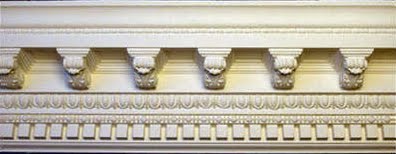
Our local plaster specialist, Plaster Supplies in Hamilton, was very helpful, and is able to custom make everything we need for Willowbrook. A veteran plasterer and designer himself, he was very excited about the opportunity to work on a period home, and was able to show us some of the 150 year old cornice moldings that he had in storage, which he hasn't had any call to use - until now! They are also going to make the 10 foot plaster ceiling dome for the foyer from our drawings. I imagine that it will end up looking something like the one above.

They had a lot of other nice Georgian period ceiling roses and plaster details...


The ceiling roundel above will be used in the Chatsworth Suite.
The roundel below will be used in the Blenheim Suite


We will use this Adams style cornice in the Wedgwood Room...


With matching ceiling roundel...


And matching fireplace surround...


We plan to use the bottom of the pediments pictured above over the door inside the Blenheim suite (c.f. the Chinese Room in Claydon House), the third from the top for the Chatsworth suite,.
We will use the second from the bottom for quite a few other pediments.

The pediments for the main foyer will be made out of the same pattern as the cornicing for the foyer, shown below...


We will also use one of these friezes to run up the staircase below the balusters, and continue around the floor, similar to the idea featured in the second picture below...


We have even found some period vent grills / covers, to go over the air-conditioning ducting...

All pictures on light blue background are from Ceiling Panels Australia's catalogue. Our local plasterer imports from them directly.


There are other plaster suppliers in NZ who also have some good cornices and roundels:

Carrara

Plastercraft

Whilst we were poking around the plasterer's workshop looking at the antique cornicing, we noticed one that seemed to be carved out of wood. It had a lovely mahogany finish to it, and the detailing was quite intricate. Actually, it turned out to be made out of plaster, like the others, but had been coated in shellac, to look just like mahogany. It was very well done. For both the studies, and the billiard room, we were going to have carved mahogany panels, but now plan on having a mixture of wood and shellaced plaster detailing. The production time is significantly shorter, and it can be done for a fraction of the cost.

Shellac is a resin secreted by the female lac bug, Laccifer (Tachardia) lacca Kerr, which is found on trees in the forests of India and Thailand. The bug forms a tunnel-like tube as it traverses the branches of tree. Though these tunnels are sometimes referred to as cocoons, they are not literally cocoons. This insect is in the same family as the insect from which cochineal is obtained.

Above: Lac Bug (beetle)

It is processed and sold as dry flakes, which are dissolved in alcohol to make liquid shellac, which is used as a brush-on colorant, food glaze and wood varnish. Shellac functions as a tough all-natural primer, sealer, tanin, odour and stain blocker. Shellac was once used in electrical applications as it possesses good insultation qualities and it seals out moisture. Gramaphone discs were also made of it during the pre-1950s, 78-rpm recording era.


Above: Shellac flakes in differing shades

The least coloured shellac is produced when the insects are parasitic upon the kursum tree, (Schleichera trijuga). The raw shellac, which contains bark shavings and lac bug parts, is placed in canvas tubes (much like long stockings) and heated over a fire. This causes the shellac to liquefy, and it seeps out of the canvas leaving the bark and bug parts behind. The thick sticky shellac is then dried into a flat sheet and broken up into flakes. It is then mixes it with denatured alcohol on-site a few days prior to use in order to dissolve the flakes and make liquid shellac.

Shellac is often the only historically appropriate finish for early 20th-century hardwood floor, wall and ceiling paneling. From the time it replaced oil and wax finishes in the 1800s, shellac was the dominant wood finish in the western world until it was replaced by nitrocellulose lacquer in the 1920s and 1930s.

Multiple thin layers of shellac produce a significantly better end result than a few thick layers—thick layers of shellac do not adhere to the wood or plaster well, and thus can be peeled off with relative ease; in addition, thick shellac will fill in (and thus ruin) carved designs in wood and other substrates.

Shellac naturally dries to a high-gloss sheen. For applications where a flatter, more matte finish is desired, products containing amorphous silica, such as "Shellac Flat," may be added to the dissolved shellac.

Shellac naturally contains a small amount of wax (3%-5% by volume), which comes from the lac bug. In some preparations, this wax is removed (the resulting product being called "dewaxed shellac"). This is done for applications where the shellac will be coated with something else (such as paint or varnish), so that the topcoat will be able to stick. Waxy (non-dewaxed) shellac appears milky in liquid form, but dries clear.


The finished product looks something like this...

Related Posts Plugin for WordPress, Blogger...