Blessings +
David and Peter Lord Cowell


There has been a quality control of goods made of silver since the 14th century and the organisation that regulates the craft, Goldsmiths Hall, has given England and the world the term "hallmark".
Every piece of silver made must be sent to the Assay Office for testing to ensure that it is of the required standard of sterling silver and, provided it conforms to that standard, a series of symbols are stamped on to each separate part of each article which today, and for the last several centuries, can show the place and year of manufacture, as well as who made or sponsored the item. With the help of a pocket-sized hallmark book and a little bit of explanation from someone who knows how to "break the code," it is great fun and also a way of perhaps finding a piece that was made in a year or city that might hold particular relevance and provide the perfect gift or commemorative item.
The law imposed on silver hallmarking is very strict and if the standard does not comply the article will not be hallmarked and probably destroyed.
A false hallmark has always been treated with the utmost severity within the law. Historically, a silver smith was pilloried for their first offence and they would be pelted with rotten fruit and vegetables. If they offended again, a limb would be hacked off and, until the 1720's, the death penalty was the sentence meted out to persistent offenders. The reason for this seemingly Draconian behaviour was that the manufacture of silver and gold was allied to the minting of currency. Therefore, by debasing these metals one was, in effect, undermining the coin of the realm, which was a treasonable offence - the ultimate quality control!
From 1696 to 1720 the standard of silver was raised from 92.5% to 95.8% pure. It was denoted by the figure of Britannia and the ‘lion’s head erased’.
Sometimes called the Sterling Mark, the lion passant, the mark for ‘made in England’, first appeared on English silver and gold in 1544. For two years it was crowned, but has been struck ever since in its present form, with minor variations, by all English Assay Offices.
Used from the inception of the Assay Office in 1773 , the Crown was the town mark of Sheffield. Because of possible confusion with the Crown mark used after 1798 as the hallmark for 18ct gold the mark was changed on January 1st 1975 for a rose which had incidentally, been used as the gold mark of Sheffield when the Assay Office there was entitled to test the mark gold after March 1st 1904. Between 1708 and 1853 the crown is often incorporated with the date letter struck on small objects.
When the Birmingham Assay Office was established in 1773, largely due to the representations of the great Midlands industrialist, Matthew Boulton, the mark of an anchor was adopted as the town mark. By tradition, it is said that Birmingham and Sheffield tossed for the marks derived from the sign of the Crown and Anchor tavern in London - where the promoters of the two new offices met. On the occasion of the Assay Office’s bicentenary in 1973, Birmingham struck a special anchor with a ‘C’ on either side of the stock, to indicate two hundred years.
The first hallmark to be used was the leopard’s head, in the year 1300. In that year, a decree by Edward I laid down that silver or gold could not be made or sold unless it was marked by the leopard’s head or ‘The King’s Mark’ as it was then known. This mark became ‘crowned’ in 1478 and remained ‘crowned’ until 1821. Since 1821, the uncrowned leopard’s head has remained as the distinguishing mark of London.
Scottish hallmarks have been regulated by statute since 1457 but the earliest known example dates only from 1556 – 7. The Incorporation of Goldsmiths of the City of Edinburgh was thought to be in the 1490’s and the earliest surviving records date from 1525.
The hallmarking of Irish silver began towards the middle of the 17th century. The mark of origin is the Harp Crowned and it appears with a date letter and maker’s mark. In 1731, the figure of Hibernia was added.
The one piece I would like to add to our collection of (mainly Georgian) silver is a cow creamer...
I have coveted one ever since I saw this episode of Jeeves and Wooster...
Aunt Dahlia is determined to get a silver cow creamer for Uncle Tom, but Sir Watkin Bassett beats her to it. So Dahlia enlists Bertie to steal the creamer for her. Bertie is reluctant to get involved in the matter, having had some past experience with Sir Watkin, but it seems he has no choice in the matter.
Arriving at Tottleigh Towers (actually Highclere Castle in Hampshire), Bertie finds Gussie once again on the outs with Madeline Bassett, and himself blackmailed by Stiffy Bing, who also wants him to steal the cow creamer so that her fiance, "Stinker" Pinker, can seemingly find it and impress her uncle, Sir Watkin. Roderick Spode has different ideas, and warns Bertie off, threatening bodily harm if anything happens to the cow creamer. All seems lost until Jeeves puts his mind to the matter, discovers some evidence to get rid of Spode, and manages to settle the matter of the cow creamer to the satisfaction of Aunt Dahlia...


For a man of the city, Osterley not only represented somewhere green and tranquil, but also a source of income. Described as 'a most fertyle place for wheate' the estate had ample resources. Gresham established one of the first paper mills in England here.
Nicholas Barbon acquired Osterley in 1683. An opportunist, he used Osterley as security to raise a large sum of money. He died in debt and in 1713 Osterley went to Sir Francis Child in payment of his loan.
Apprenticed to a London goldsmith at the age of fourteen, by a judicious marriage Sir Francis found himself the partner and then sole owner of the firm. By 1698 he was Lord Mayor of London and had expanded his business into banking with the creation of Child's Bank.
Over the next two generations, the family's wealth and position grew. In 1761 Robert Adam, the most fashionable architect of the day, was commissioned by Sir Francis's grandson, another Francis, to modernise the house. He transformed it into what you see today, remodelling the outside and designing the interiors and a great deal of the furnishings. His vast portico makes a particularly grand statement of classical refinement.
The house is of red brick with white stone details and is approximately square, with turrets in the four corners. Adam's design, which incorporates some of the earlier structure, is highly unusual, and differs greatly in style from the original construction. One side is left almost open and is spanned by an Ionic pedimented screen which is approached by a broad flight of steps and leads to a central courtyard, which is at the piano nobile level.
Above: Robert Adam
The unity of design was carried through into the park by Francis and, on his death in 1763, by his brother Robert Child. They redirected rivers to form a chain of sinuous lakes through the Park, and created a drive which brought people in a tantalising loop before finally arriving at the House.
Not active as an MP or in running the bank, Robert Child spent a great deal of time at, and money on, Osterley. His wife was equally involved and she lived on at Osterley for 10 years after his death.
By the beginning of the 19th century, Osterley was no longer a main residence and, apart from a few brief periods of occupation, would not be so again. In 1923, the 9th Earl of Jersey inherited Osterley at the age of 13. He opened the house to the public in 1939 because he said, 'he did not live in it and …many others wished to see it'. In July 1939, the Georgian Group held a great ball at Osterley.
Adam's neoclassical interiors are among his most notable sequences of rooms. Horace Walpole sarcastically described the drawing room as "worthy of Eve before the fall." The rooms are characterised by elaborate but restrained plasterwork, rich, highly varied colour schemes, and a degree of coordination between decor and furnishings unusual in English neoclassical interiors.
Above and Below: Examples of the colourful interiors and rich plaster work
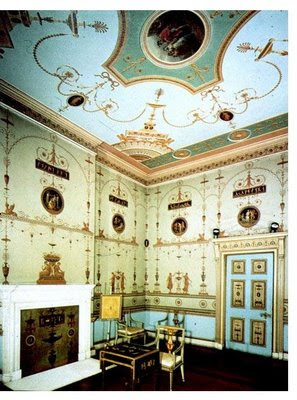
Above: The Etruscan Dressing Room
Notable rooms include the entrance hall, which has large semi-circular alcoves at each end, and the Etruscan dressing room, which Adam said was inspired by the Etruscan vases in Sir William Hamilton's collection, illustrations of which had recently been published. Adam also designed some of the furniture, including the opulent domed state bed, still in the house (below)
For all the readers of this blog: the authors of this blog endeavour to their best ability to give proper credit when credit is due to all authors, artists, photographers, and other bloggers to ensure that their intellectual property is recognised.
Whilst all care is taken to ensure any pictures used are in the public domain, or are allowed to be reproduced with credit given, it is possible for genuine mistakes to be made.
Should a picture or other file be published on this blog, which you know it to be your property, please post a comment to that effect, stating whether you wish additional credit to be given to you, or whether you wish the item in question to be removed, and it will be removed as expediently as possible with the sincerest of apologies.
Should you wish to use photographs or other files found on this website belonging to the authors, that is fine. If it is clearly an original photograph of Willowbrook Park, we merely ask that you provide a link to the post where you found the picture.
We hope that with everyone’s co-operation we can continue enjoying blogging courteously, and without any offense caused to any other artist or blogger.