Friday, August 3, 2012
Quinces, Jelly, and Dulce de Membrillo...
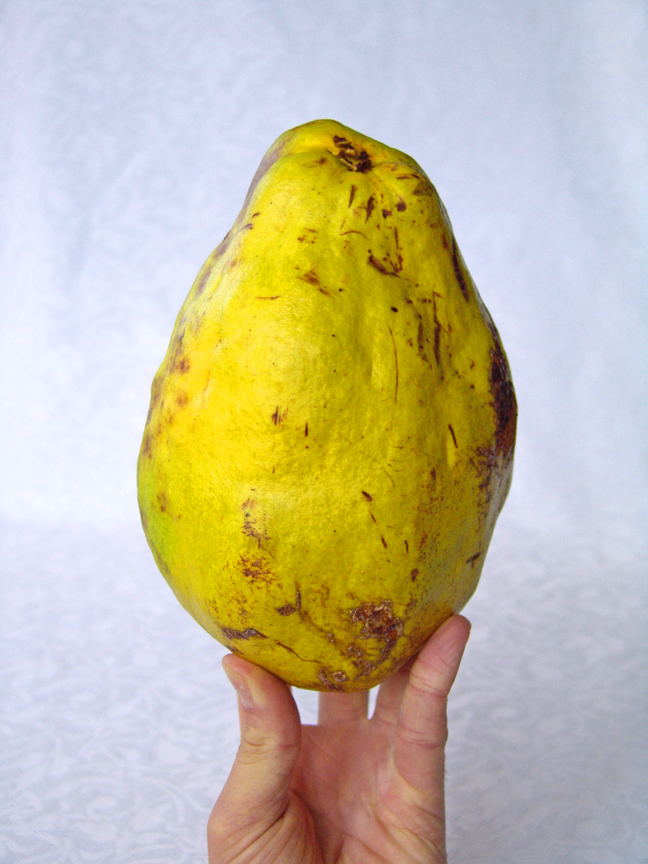
We were recently given a very large bag of Quinces. They were an old fashioned and extremely large variety, as you can see.
Quince is a fruit native to the Mediterranean and the middle east. The tree is a member of the rose family and has stunning blossoms.
Quinces were given by the ancient Greeks as a wedding gifts (as it was the fruit sacred to Aphrodite), and the Romans were fond of stewed quince with honey.
The Portuguese word 'marmalade' originally pertained only to quince jelly, the Portugese word for quince being marmel. In latin american countries the fruit is made into a thick paste, known as Dulce de Membrillo, thicker than quince jelly and cut into thick sweet slices which offset the taste of a decent Stilton or Roquefort perfectly.
So, laden with 100 pounds of giant quinces we set to work.. We followed a friend's recipe...
Scrub the outside of the quinces well, and add the roughly chopped pieces, seeds and all, to a large pot. Add just enough water to stew the fruit until it is soft a pulpy.
sieve the pulp
If you wish to make quince jelly, instead of sieving the pulp, allow it to drip in a cheesecloth overnight, collecting the clear fluid (don't squeeze the cheesecloth, or you will end up with cloudy jelly). Add sugar to the clear fluid and boil until thick enough to set as jelly.
We tried to make a little of the mixture into jam by adding a little water and lemon juice to part...
for quince paste or Dulce de Membrillo return the seedless pulp to the pan and add sugar pound for pound. Boil whist stirring constantly for at least and hour, until the consistency and colour turn dark and tacky. Leave it to set into thick delicious Membillo...
Add the finishing touches, slice, and enjoy the fruits of your labour...
Labels:
Dulce de Membrillo,
Jam,
orchard,
Paste,
Preserves,
Quince,
Recipes,
Willowbrook Park Cookbook
Wednesday, July 18, 2012
Our Hairy Coos Have Arrived...
Our Highland Cattle arrived after work today. Light was fading quickly on a mid-winter's day, but still managed to get a few pics. Now we just have to think of nine Scottish names. Any suggestions...
Sunday, July 15, 2012
Balmorality....
Balmorality: Abstract noun; an enthusiasm for a stereotyped Scottish aesthetic.
I was prompted to do this post after being given several well chosen gifts from my mother for the Balmoral / Billiard room at Willowbrook - A large set of pewter deer antlers, a pair of pewter stag book ends, and a pewter sculpture of a stag and a doe.
They reminded me of a documentary I had seen about Balmoral Castle, and the Victorian aesthetic movement known as Balmorality. Victoria and Albert were enamoured with a very romantic ideal of Scotland, the sort portrayed by the Scottish poets and novelists, such as Sir Walter Scot. They made their castle a concentrated pastiche of this stereotyped 'scottishness'.
Photo: Stuart Yeates
Above and Below: Balmoral Castle
Balmoral Castle was first leased by Prince Albert in 1848 and subsequently purchased in November 1851. The 15th-century house was soon regarded as inadequate and was replaced by an entirely new, larger building. Prince Albert helped with the design, and Queen Victoria wrote proudly, ‘all has become my dearest Albert’s own creation, own work, own building, own laying out’.
The interiors of Balmoral were given a strong Scottish flavour. The carpets, curtains and upholstery were in a range of tartans, including ‘Hunting Stuart’ and ‘Balmoral’, designed by Queen Victoria and Prince Albert. Wallpaper incorporated patterns of thistle and heather, and the walls were hung with drawings by Edwin Landseer and prints of his paintings, mostly Highland scenes. In the Drawing Room there was a remarkable set of 12 candelabra in the form of Highlander figures holding deerstalking trophies, a collaboration between two British manufacturers, Minton and Winfield. Furniture was made by the London firm of Holland & Sons to simple but high-quality designs, mostly in light woods, such as satin birch or pine. Pieces for the most important rooms were embellished with silvered mounts, decorated with the royal couple’s ciphers or Scottish symbols.
Every year the Queen and the Prince travelled north for their autumn Highland holiday, enjoying the home of their own making and the freedom they found there. Prince Albert made his final visit to Balmoral in 1861, just months before he died. The Queen continued the tradition of the annual Highland stay following Prince Albert’s death, making her last visit to the Castle in 1900.
Stag heads and tartan abounded. Unsurprisingly, this style has continued to be popular periodically, with ever changing contemporary twists.
Taxidermy in general has a sort of Baronial style about it, though not always tasteful...
I very much like the stag wallpaper. No animals harmed in the making thereof...
Tartan of course figures heavily in the Balmorality movement. Tartan was briefly outlawed with the 1746 Dress Act after the Jacobite Rebellions (with the exception of the black watch Regiment).
Photo: eclecticrevisited.com
Photo: interior-freedom.blogspot.com
Photo: Alkemie.blogspot.com
Here is the vintage documentary about Balmoral, including a good explanation of Balmorality...
For those interested in tartan decor and scottish themed style, you might like to check out Tartanscot's blog.
For those interested in Taxidermy, see our previous posting.
Thursday, July 12, 2012
Canterbury Tales Part Two...
The next day we went up into a forest and practised shooting some clay pigeons with our host's new Beretta. We fired down the line between these trees..
Our hosts were great shots...
We didn't do too badly either...
We were both given a recap on basic firearms safety and then some tips on shooting the clays before getting right into it...
It was great to try out his SV 10 Perennia, as I am still shopping around to decide which shotgun I'll end up getting. Quite impressed with the Beretta, and it would go so well with my Wellingtons...
I didn't do so badly. Once I got into my stride I was hitting them almost every time. When I tried from a gun down position I didn't have as much luck. I am going to join the Waikato Clay Target Club, which is just down the road from Willowbrook, so that I can really brush up on my skills for next time...
Labels:
Clay Pigeon,
Duck Shooting,
Shooting,
Shooting Clothing,
Shooting parties,
Skeet
Tuesday, July 10, 2012
Canterbury Tales Part One...
Last week we enjoyed a stunning mini-break catching up with friends down in Canterbury. We had a great time, with plenty of great wine and food. After exploring the international Antarctic centre on Thursday, we mooched around a few antique shops enjoyed a couple of pints at the few pubs which are still standing in Christchurch, and then went home for a dinner of slowly cooked beef chaps with seasonal vegetables and red wine. The next day after a much needed sleep-in we set off on a mystery tour our hosts had arranged.
After some guerilla gardening we were set to go...
We were taken on a lovely scenic tour of southern Canterbury, stopping in historic Oamaru for lunch at a Victorian tea room and visiting the heritage district where all the buildings are of historic importance. Then our journey continued, ending at twilight when we arrived at the small historic vicarage of St Alban's outside Kurow...
It was built in the late 1800s out of hand hewn Oamaru limestone and is situated near the foot hills of the Southern Alps.
"Between 1881 and 1891 the
Anglican community in and around Kurow was served by curates who resided
locally but who were appointed to the vicar of Oamaru. In 1891 this situation
changed, however, when the Waitaki Mission District was established and Hugh Corrie
Frere was appointed as the first curate of the new parish. At the same time
Emily Campbell, wife of the late Robert Campbell who was one of North Otago's
leading landowners, left a large bequest of approximately £5300 to finance the
erection of a church and vicarage in the district.
Emily Campbell's generosity proved to be somewhat
of a mixed blessing, however, as the Anglicans of Duntroon initially disputed
Kurow's suitability as the parish's centre. The New Zealand Church News of
August 1892 records that Mrs Campbell's legacy was causing divisions within the
district's Anglicans although "Kurow (was) really the proper centre of
operations, and ought probably to have both the church and parsonage". [NZ
Church News, Vol XXII, No. 8, p7]. Happily the controversy was eventually
resolved by Bishop Nevill of Dunedin who recommended that a church be erected
at Duntroon whilst a vicarage and adjoining chapel were built at Kurow. £2,500
was subsequently allocated for the construction of the latter, which began
forthwith, although St Martin's Church at Duntroon was not erected until 1901
to a design by Christchurch architect, Thomas Cane.
The large size of the Kurow vicarage may in part
be explained by the fact that the first incumbent at St Alban's had a large
family and a private income with which to pay domestic and stable staff. The
last resident vicar at Kurow vacated the house in 1970."
The vicarage has now been turned into bijoux accommodation, which our hosts had hired for the weekend.
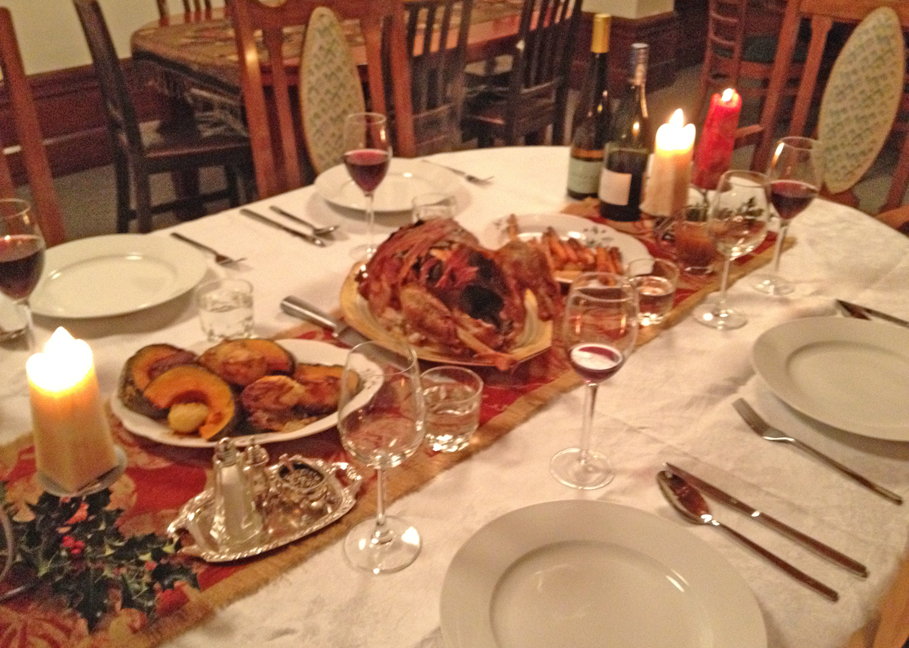
Later the reason for the impromptu holly pruning was revealed, the holly being needed to trim the table for a mid-winter Christmas dinner...
The next day we continued our tour around the lakes of South Canterbury ...
...before returning home by night fall for another lavish spread.
The next day we went to look at a large plot of land they had purchased outside Christchurch, complete with a stream filled with brown trout and wild watercress..
Part 2 Tomorrow...
Labels:
Architecture,
chapel,
Christchurch,
Dinner,
Earthquake,
masonry,
Masonry details,
Private chapel,
Trout
Subscribe to:
Posts (Atom)