Wednesday, January 19, 2011

Summer hay harvest time again...


Above: Hay at Willowbrook Park January 2011

Below: Medieval painting of hay makers


Samuel Woodworth (1784-1842).
“The Hay-makers”
from The poetical works (1861)

It is sweet, love, to stray,
When the noon-tide is over,
Through the windrows of hay,
And the white-blossomed clover;
...
Where each lass may partake
In the toil and the pleasure,
Keeping time, with the rake,
To the lark's tuneful measure.
Oh 'tis sweet thus to stray,
When the noon-tide is over,
Through the windrows of hay,
And the white-blossomed clover.

There the swains cut their paths
Through the sections assigned them,
Leaving sweet-scented swaths
Swelling gayly behind them.
Tender childhood and age,
Sturdy manhood and beauty,
All with ardor engage
In so pleasing a duty.
Oh 'tis sweet thus to stray,
When the noon-tide is over,
Through the windrows of hay,
And the white-blossomed clover.

As the billow of grass
Over the meadow is driven,
By some rose-visaged lass
'Tis divided and riven,
When her swain lends his aid,
And the green hillock rises,
...
Then the half-willing maid
With a sly kiss surprises.
Oh 'tis sweet thus to stray,
When the noon-tide is over,
Through the windrows of hay,
And the white blossomed clover.

See the gay romping elves,
Now the sweet task is over,
All amusing themselves,
On the balm-breathing clover;
There the swain whispers love
To his heart's dearest treasure,
Who affects to reprove,
While her eyes beam with pleasure.
Oh 'tis sweet thus to stray,
When the noon-tide is over,
Through the windrows of hay,
And the white-blossomed clover.


While we at Willowbrook make hay amidst our mild drought, we remember our neighbours across the Tasman whose lives have been traumatically turned upside down by the unprecedented flooding, and pray for a speedy halt to the rain and a quick recovery.

Friday, January 14, 2011

The Fabulous Beekman Boys

Recently one reader brought it to my attention that We here at Willowbrook might share something in common with The Fabulous Beekman Boys, so we had to investigate this further to find out whether he was right.


The Beekman Boys are two lads from Manhattan, who star in a reality television show about their transition from city life to that of gentlemen farmers. Josh Kilmer-Purcell and his partner Brent Ridge have become lifestyle farmers and have launched their own brand, Beekman 1802.

Brent, a physician who later worked for Martha Stewart, lives at the farm full time, while Josh, an author, commutes from their apartment in New York City to the farm at the weekend.

The series chronicles the couple's trials and tribulations as novice farmers, aided by their resident farmer John Hall - "Farmer John." The goats on the farm seem to play a predominant role. 'Farmer John' brought his goats to the Beekman Farm shortly after Brent and Josh purchased it in 2007.

It does take a while for some things to filter as far as New Zealand, and unfortunately I doubt the show will be broadcast here in the near future (but that's what DVDs are for). In the meantime, there are some clips from the show available at the Planet Green website.

There is also their hilarious 'Goat-Cam' for when one gets really bored (I always know what our goats are up to, as they are always up to no good (getting stuck in fences or eating our hedging).

Both of the boys have their own blogs:


or


Lucindaville and Hello Gorgeous have both enlightened us to the fact that the Beekman boys now have a book out (once again, not available in NZ, but that is what Amazon is for).


Now I shall just have to wait with anticipation for the post to arrive...

Wednesday, January 12, 2011

The Wallace Collection...


In this post we ferry back across the channel to visit where some of the highest quality pieces of Boulle furniture ended up: the Wallace collection. There is nothing better to do on a rainy afternoon in London than to pop down to the Wallace Collection, in Manchester Square, to marvel at the beautiful art amassed within. This charming and thankfully oft forgotten collection is discretely located in Hertford House.

The Wallace Collection has a range of fine and decorative art from the 15th to the 19th centuries with large holdings of French 18th-century paintings, Boulle furniture (Regardez vous le exemple ci-dessus), arms & armour, and porcelain; arranged into 25 galleries.

It was established in 1897 from the private collection mainly created by Richard Seymour - Conway, the 4th Marquess of Hertford (1800–1870), who left it and the house to his illegitimate son Sir Richard Wallace (1818–1890), whose widow bequeathed the entire collection to the nation (on his orders).

The museum opened to the public in 1900 in Hertford House, and remains there, housed in its entirety, to this day. A condition of the bequest was that no object ever leave the collection, even for loan exhibitions.


The History of Hertford House and the Wallace Collection


From 1791-95 'Hertford' House was used as the Spanish Embassy. However, in 1797 the 2nd Marquess of Hertford Francis Ingham Seymoure-Conway(b.1743-d.1822) acquired the lease of the house. He was a Lord of the Treasury (1774-82), Ambassador to Berlin and Vienna (1793-4) and Lord Chamberlain (1812-21). The 2nd Marquess used the house as his principal London residence, holding many parties there, the most prestigious of which was the Allied Sovereigns’ Ball held after the defeat of Napoleon in 1814.

Of works of art now in the Wallace Collection he bought two fine English portraits, Reynolds’s Nelly O’Brien and Romney’s Mrs Mary Robinson (‘Perdita’), and was given Gainsborough’s portrait of Mrs Robinson (who was a family friend) by the Prince of Wales. He also acquired a few pieces of French furniture and Sèvres porcelain.

Above: Gainsborough's Mrs Mary Robinson ‘Perdita’

Below: Romney’s Mrs Mary Robinson ‘Perdita’

The 3rd Marquess, Francis Charles Seymour Conway (1777-1842) let the house as the French Embassy from 1836-51. He married well, but against his parents wishes. His wife, the daughter of a dancer, benefitted greatly from 2 men, the 4th Duke of Queensberry and his associate George Selwyn, who each believed that he was her father. However, the 3rd Marquess' marriage was not to last long. In 1802 they visited Paris, where they became estranged and from that time led separate lives. She remained in Paris, while the 3rd Marquess established splendid residences in London at Dorchester House (on the site of the present Dorchester Hotel) and at St Dunstan’s Villa in Regent’s Park (demolished in 1937).


Above: Titian’s Perseus and Andromeda

His later life was devoted largely to foreign travel to the extent that he was the model for the sinister figure of Lord Steyne in Thackeray’s Vanity Fair. However, he was a considerable connoisseur. He bought Titian’s Perseus and Andromeda and seventeenth-century Dutch paintings such as Netscher’s The Lace Maker and Rembrandt’s Good Samaritan as well as French furniture, gilt bronzes and Sèvres porcelain.


A Sevres inkwell given to Marie Antoinette by Louis XV

He also acted as a saleroom agent for the Prince of Wales, for whom he bought forty outstanding Dutch and Flemish pictures which remain in the Royal Collection. Both men were attracted by the luxury and refinement of eighteenth-century French art and, like many other English collectors, profited from the break-up of many Continental collections during the French Revolution and the Napoleonic wars.

Hertford House then passed to the 4th Marquess (b.1800-d.1870) who lived largely in Paris and used Hertford House as a London store for his increasing art collection.

He was briefly an M.P. and a cavalry officer, but by 1829, when he bought a large apartment at no.2 rue Laffitte, he had determined to forgo any public duties and to settle in Paris.

In 1835 he also bought the château of Bagatelle in the Bois de Boulogne. The 4th Marquess never married. Witty and intelligent as well as one of the richest men in Europe, he sometimes ventured into Parisian society and became friendly with Napoleon III. But there was a neurotic side to his personality and he preferred a reclusive life.

The last thirty years of his life were devoted to collecting works of art. He brought Dutch paintings (including Rembrandt’s Titus and Hals’s The Laughing Cavalier), many superb Old Masters (including masterpieces by Poussin, Van Dyck, Velázquez and Rubens) and most of the nineteenth-century paintings now in the Wallace Collection.

Like his father, he was attracted by the superb craftsmanship of eighteenth-century France, but he acquired a wider range of objects and on a far larger scale. He bought pictures by Watteau, Greuze, Boucher and Fragonard; many fine pieces of Sèvres porcelain; furniture by the greatest French cabinet-makers such as Gaudreaus and Riesener, as well as miniatures, gold boxes, tapestries and sculpture. In his last decade he acquired the important collection of Oriental arms and armour and also bought some major European pieces.

He usually bought at auction through agents, preferring pleasing and sensuous works of art, and he attached great importance to good condition and a known provenance.

More than any other Founder, it is his taste that has determined the character of the Wallace Collection we see today. He died at Bagatelle in August 1870 as the Prussian army advanced on Paris, bringing Napoleon III’s Second Empire to an end. He bequeathed his unentailed property, including his great collection, to his illegitimate son, Richard Wallace. The Marquisate was inherited by a second cousin.

It was only with the Paris Revolution of 1871 that Richard Wallace decided to move back to London, bringing a substantial amount of his Parisian collection with him.

He redeveloped the house, creating a range of galleries on the first floor. After his death the house was converted into a public museum by the Office of Works and first opened as a museum on 22 June 1900.

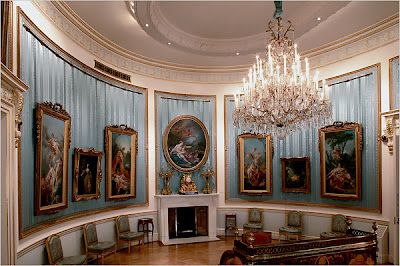
Some of the rooms which house the collection:


...I love walls upholstered with watered silk...

. . . . . .


Below: The Oval Drawing Room

For further information and a catalogue of the collection visit the official website here

Thursday, January 6, 2011

What a load of old Boulle...


Carrying on the French theme of artisans of the court of Louis XIV-XV, I thought I would write a small post on the exquisite marquetry work of André-Charles Boulle, and his école.

Today the name Boulle is synonymous with his distinctive style of inlaid furniture. His career started in 1666 as a master cabinetmaker. In1672 the king granted him the royal privilege of an apartment in the Palais du Louvre. Later that year, he became 'Cabinetmaker and sculptor to Louis XIV, king of France'. This new title allowed him to produce furniture as well as works in gilt bronze such as chandeliers, wall lights, and mounts. Although strict guild rules usually prevented craftsmen from practicing two professions simultaneously, Boulle's favoured position exempted him from these impositions.

He devoted himself to creating expensive and time-consuming furniture and objects d'art with brass and pewter inlays for the king and court. He specialized in the inlaying of ebony with precious woods and mother-of-pearl. Large areas were covered with tortoiseshell, inlaid with filigrees of gilded brass. He added splendid bas-relief compositions, as well as sculptured rosettes, masks, and acanthus scrolls, all in gilded bronze.

Although he did not invent this style of marquetry, he devised a new process by cutting out patterns from these materials. He thus obtained two panels: the “part” and the “counterpart”. The first was in copper on a background of tortoiseshell, the second in tortoiseshell on a background of copper. This usually meant that there were two complimentary pieces of furniture made with each corresponding part and counterpart.


Above and Below:

A Boulle régence styled clock and pedestal in the Lord Cowell collection.


Boulle-made original pieces were considered highly fashionable and were prized in France in the late 17th century and throughout the 18th century. Given their popularity, in the last half of the 19th century, modern machine techniques were utilized to enable the creation of large quantities of furniture in the Boulle style.

Superb examples of his art exist at Versailles, Fontainebleau, and the Louvre and in England at Windsor Castle and in the Wallace Collection, London. The title cabinetmaker to the king passed to his four sons, Jean Philippe, Pierre Benoît, André Charles, and Charles Joseph.

Many of his designs are illustrated in a book of engravings published around 1720. Boulle's pieces, having in general the character of Louis XIV and régence design, were built for the immense formal rooms of the period. In 1684-1692, the Grand Dauphin commissioned in Boulle marquetry the panelling and parquet of his study in Versailles, lost in the 18th century.

Above: Candelabra stands

Above: A Boulle Ink Well

Below: One of the many Boulle-styled clocks after a rococo fashion


Above and Below: Typical consoles in his style.


More Boulle pedestals...

and a Regency drum table...

He was by no means the first craftsman to practice the delicate art of marquetry, nor was he the inventor of the inlay of brass or pewter and tortoiseshell which is associated with his name; but no artist, before or since, has created works of such astonishing skill.

Tuesday, December 28, 2010

Sèvres Porcelain...


Some of you will recall my fondness for Wedgwood China (Post One and Two). I do collect other styles of china as well, and have recently come into possession of two Sevres-style porcelain and ormolu garnitures. They would have originally belonged to a clock with matching porcelain panels. Alas, the clock was not with the garnitures when I found them.

I had never really been a huge fan of Sevres, finding much of it, like Limoges, slightly twee and gaudy. However, somehow these two ended up coming home with me on a recent sojourn and are now in the drawing room...


This prompted me to look further into the provenance of the items. They are stamped and dated as early 19th century pieces. They are definitely not as fine as some Sevres garnitures...


and the Sevres clocks that go with them...


The history of Sevres porcelain starts in 1738 when the Marquis Orry de Fulvy, brother of the Minister of Finance, obtained a licence to manufacture Saxon styled porcelain
At that time the brothers Dubois, who were arcanists that fled from Chantilly, had already experimented to produce porcelain at the Chateau de Vincennes. Together with Gravant, they succeeded to produce a type of soft paste frit-porcelain around 1745.
Sevres porcelain history starts in 1738 when the Marquis Orry de Fulvy, brother of the Minister of Finance, obtained from the French king Louis XV a licence to manufacture porcelain in the Saxon manner
At that time the brothers Dubois, who were arcanists that fled from Chantilly, had already experimented to produce porcelain at the Chateau de Vincennes. Together with Gravant, they succeeded to produce a type of soft paste frit-porcelain around 1745.
from Louis XV.
Sevres Porcelain traces its roots in France to early craftsmen in Lille, Rouen. St. Cloud, and most notably Chantilly. In 1738 the workers from Chantilly migrated to the Chateau de Vincennes near Paris and formed a larger porcelain factory. French King Louis XV, perhaps inspired by his mistress Madame de Pompadour, took an intense interest in porcelain and moved the operation in 1756 to an even larger quarters in the Parisian suburb of Sevres. Sevres was also conveniently near the home of Madame de Pompadour, Chateau de Bellevue, built in 1750, and the King's own Palace at Versailles.


From the outset the king's aim was to produce Porcelain that surpassed the established Saxony works of Meissen and Dresden. Though the French lacked an ample supply of kaolin, a required ingredient for hard-paste porcelain (pate dure), their soft-paste porcelain (pate tendre) was fired at a lower temperature and was thus compatible with a wider variety of colors and glazes that in many cases were richer and more vivid.
Unglazed white Sevres Porcelain biscuit (twice fired) figurines were also popular. However, soft-paste Sevres Porcelain was more easily broken. Therefore, early pieces of Sevres Porcelain that remain intact have become rare indeed.
Despite the popularity of the pieces nowadays, the Sevres Porcelain factory suffered financial hardship on many occasions. In part this may have been due to the king's insistence that only the finest items be created - as only a limited number of European nobility could afford the extravagant prices demanded for such works. King Louis XV and his heir, invested heavily in the Sevres enterprise. In the end, the Sevres factory produced items by royal warrant and thus the well-known Sevres mark was born. King Louis XV even enacted laws that severely restricted other porcelain production in France to try to create a monopoly for his Sevres Porcelain. The king even hosted an annual New Year's Day showing for French nobility in his private quarters at Versailles and encouraged them to purchase the pieces.


Sevres Porcelain may have given Meissen and Dresden a run for their money, but the French Revolution saw the works practically out of business due to the economic devastation of the new French Republic.
Under Napoleon Bonepart, a new director was named for the Sevres operations: Alexandre Brongniart. He resurrected Sevres. Soft-paste porcelain was eliminated altogether thanks to the discovery of kaolin near Limoges. The market started to open up to the middle classes with more reasonably priced items being made, and for the next forty years business boomed. Today the factory is still in operation making fine contemporary china.


Maybe we should turn the 'Wedgewood Room' into a 'Porcelain Room' in general...


For a good potted history of Sevre go to http://www.antique-marks.com/sevres-porcelain.html
Related Posts Plugin for WordPress, Blogger...