Saturday, January 22, 2011

The Lion's Share...


Just like Sphinxes, Lions have been a popular theme for estate ornamentation over the centuries. They are ubiquitously found in masonry, garden ornamentation and interior decor. Having decided that we would like to include them on our estate, starting with our Entrance, we happened upon two such noble beasts, perfect for the job. They are made of sandstone from the West country and originally belonged to an estate in Wiltshire. They will be mounted atop the gate pillars to watch over the comings and goings...


Above: One of the lions (iphone photos are not the great I'm afraid)

They stand about 4 feet tall, and have crowned lions rampant on the shields they hold (an emblem found of our own Family crest by chance). They should look great upon the gate pillars.

The other place we have decided to incorporate lions is in the front courtyard fountain. There shall be a large, traditional masonry fountain in the middle of the courtyard, inside a flower parterre, with four lions semi-passant (identical to the ones below) standing in the parterre around the outside of the fountain pool, roaring water out of their mouths, back into the pool (ours will be farther away from the pool so that the water from their mouths lands in the pool and not on the fountain).


Above: Lovely, but the lions will be standing around the outside facing back into pool


There are other famous styles of lions used on estates over the centuries. Here are some below.

Dear Readers, please feel to comment with links to more impressive or different examples that are known to you.


Below: A lion statant in Great Park, Windsor

A More Medieval depiction of a lion perhaps than most extent sculptures


The very majestic example on the South bank by Westminster bridge...


Some fierce Italian reproduction numbers...


A winged, semi-sphinx-like lion sejant...


Cowering lions - not the most noble look...


Some couchant inspirations...


The other way One can incorporate lions, in a traditionally English way, is as large brass Lion-Mask door knockers...


Finally, a little FYI explanation of the heraldic terms used to describe the 'Attitudes' (postures) of lions and other mythical beast whom you may encounter...

Attitude Example Description
Rampant
Lion Rampant.svg
A "lion rampant" is depicted in profile standing erect with forepaws raised. The position of the hind legs varies according to local custom: the lion may stand on both hind legs, braced wide apart, or on only one, with the other also raised to strike; the word rampant is often omitted, especially in early blazon, as this is the most usual position of a carnivorous quadruped;

Note: the term segreant denotes the same position, but is only used in reference to griffins and dragons

Passant
Lion Passant.svg
A "lion passant" is walking, with the right fore paw raised and all others on the ground. A "Lion of England" denotes a lion passant guardant Or, used as an augmentation

Note: A lion thus depicted may be called a "leopard" (see discussion below).

Statant
Lion Statant.svg
A "lion statant" is standing, all four feet on the ground, usually with the forepaws together. This posture is more frequent in crests than in charges on shields.
Salient
Lion Salient.svg
A "lion salient" is leaping, with both hind legs together on the ground and both forelegs together in the air. This is a very rare position for a lion, but is also used of other heraldic beasts.
Sejant
Lion Sejant.svg
A "lion sejant" is sitting on his haunches, with both forepaws on the ground.
Sejant erect
Lion Sejant Erect.svg
A "lion sejant erect" is seated on its haunches, but with its body erect and both forepaws raised in the "rampant" position (this is sometimes termed "sejant-rampant").
Couchant
Lion Couchant.svg
A "lion couchant" is lying down, but with the head raised
Dormant
Lion Dormant.svg
A "lion dormant" is lying down with its eyes closed and head lowered, resting upon the forepaws, as if asleep.

Above examples from Wikipedia

Wednesday, January 19, 2011

Summer hay harvest time again...


Above: Hay at Willowbrook Park January 2011

Below: Medieval painting of hay makers


Samuel Woodworth (1784-1842).
“The Hay-makers”
from The poetical works (1861)

It is sweet, love, to stray,
When the noon-tide is over,
Through the windrows of hay,
And the white-blossomed clover;
...
Where each lass may partake
In the toil and the pleasure,
Keeping time, with the rake,
To the lark's tuneful measure.
Oh 'tis sweet thus to stray,
When the noon-tide is over,
Through the windrows of hay,
And the white-blossomed clover.

There the swains cut their paths
Through the sections assigned them,
Leaving sweet-scented swaths
Swelling gayly behind them.
Tender childhood and age,
Sturdy manhood and beauty,
All with ardor engage
In so pleasing a duty.
Oh 'tis sweet thus to stray,
When the noon-tide is over,
Through the windrows of hay,
And the white-blossomed clover.

As the billow of grass
Over the meadow is driven,
By some rose-visaged lass
'Tis divided and riven,
When her swain lends his aid,
And the green hillock rises,
...
Then the half-willing maid
With a sly kiss surprises.
Oh 'tis sweet thus to stray,
When the noon-tide is over,
Through the windrows of hay,
And the white blossomed clover.

See the gay romping elves,
Now the sweet task is over,
All amusing themselves,
On the balm-breathing clover;
There the swain whispers love
To his heart's dearest treasure,
Who affects to reprove,
While her eyes beam with pleasure.
Oh 'tis sweet thus to stray,
When the noon-tide is over,
Through the windrows of hay,
And the white-blossomed clover.


While we at Willowbrook make hay amidst our mild drought, we remember our neighbours across the Tasman whose lives have been traumatically turned upside down by the unprecedented flooding, and pray for a speedy halt to the rain and a quick recovery.

Friday, January 14, 2011

The Fabulous Beekman Boys

Recently one reader brought it to my attention that We here at Willowbrook might share something in common with The Fabulous Beekman Boys, so we had to investigate this further to find out whether he was right.


The Beekman Boys are two lads from Manhattan, who star in a reality television show about their transition from city life to that of gentlemen farmers. Josh Kilmer-Purcell and his partner Brent Ridge have become lifestyle farmers and have launched their own brand, Beekman 1802.

Brent, a physician who later worked for Martha Stewart, lives at the farm full time, while Josh, an author, commutes from their apartment in New York City to the farm at the weekend.

The series chronicles the couple's trials and tribulations as novice farmers, aided by their resident farmer John Hall - "Farmer John." The goats on the farm seem to play a predominant role. 'Farmer John' brought his goats to the Beekman Farm shortly after Brent and Josh purchased it in 2007.

It does take a while for some things to filter as far as New Zealand, and unfortunately I doubt the show will be broadcast here in the near future (but that's what DVDs are for). In the meantime, there are some clips from the show available at the Planet Green website.

There is also their hilarious 'Goat-Cam' for when one gets really bored (I always know what our goats are up to, as they are always up to no good (getting stuck in fences or eating our hedging).

Both of the boys have their own blogs:


or


Lucindaville and Hello Gorgeous have both enlightened us to the fact that the Beekman boys now have a book out (once again, not available in NZ, but that is what Amazon is for).


Now I shall just have to wait with anticipation for the post to arrive...

Wednesday, January 12, 2011

The Wallace Collection...


In this post we ferry back across the channel to visit where some of the highest quality pieces of Boulle furniture ended up: the Wallace collection. There is nothing better to do on a rainy afternoon in London than to pop down to the Wallace Collection, in Manchester Square, to marvel at the beautiful art amassed within. This charming and thankfully oft forgotten collection is discretely located in Hertford House.

The Wallace Collection has a range of fine and decorative art from the 15th to the 19th centuries with large holdings of French 18th-century paintings, Boulle furniture (Regardez vous le exemple ci-dessus), arms & armour, and porcelain; arranged into 25 galleries.

It was established in 1897 from the private collection mainly created by Richard Seymour - Conway, the 4th Marquess of Hertford (1800–1870), who left it and the house to his illegitimate son Sir Richard Wallace (1818–1890), whose widow bequeathed the entire collection to the nation (on his orders).

The museum opened to the public in 1900 in Hertford House, and remains there, housed in its entirety, to this day. A condition of the bequest was that no object ever leave the collection, even for loan exhibitions.


The History of Hertford House and the Wallace Collection


From 1791-95 'Hertford' House was used as the Spanish Embassy. However, in 1797 the 2nd Marquess of Hertford Francis Ingham Seymoure-Conway(b.1743-d.1822) acquired the lease of the house. He was a Lord of the Treasury (1774-82), Ambassador to Berlin and Vienna (1793-4) and Lord Chamberlain (1812-21). The 2nd Marquess used the house as his principal London residence, holding many parties there, the most prestigious of which was the Allied Sovereigns’ Ball held after the defeat of Napoleon in 1814.

Of works of art now in the Wallace Collection he bought two fine English portraits, Reynolds’s Nelly O’Brien and Romney’s Mrs Mary Robinson (‘Perdita’), and was given Gainsborough’s portrait of Mrs Robinson (who was a family friend) by the Prince of Wales. He also acquired a few pieces of French furniture and Sèvres porcelain.

Above: Gainsborough's Mrs Mary Robinson ‘Perdita’

Below: Romney’s Mrs Mary Robinson ‘Perdita’

The 3rd Marquess, Francis Charles Seymour Conway (1777-1842) let the house as the French Embassy from 1836-51. He married well, but against his parents wishes. His wife, the daughter of a dancer, benefitted greatly from 2 men, the 4th Duke of Queensberry and his associate George Selwyn, who each believed that he was her father. However, the 3rd Marquess' marriage was not to last long. In 1802 they visited Paris, where they became estranged and from that time led separate lives. She remained in Paris, while the 3rd Marquess established splendid residences in London at Dorchester House (on the site of the present Dorchester Hotel) and at St Dunstan’s Villa in Regent’s Park (demolished in 1937).


Above: Titian’s Perseus and Andromeda

His later life was devoted largely to foreign travel to the extent that he was the model for the sinister figure of Lord Steyne in Thackeray’s Vanity Fair. However, he was a considerable connoisseur. He bought Titian’s Perseus and Andromeda and seventeenth-century Dutch paintings such as Netscher’s The Lace Maker and Rembrandt’s Good Samaritan as well as French furniture, gilt bronzes and Sèvres porcelain.


A Sevres inkwell given to Marie Antoinette by Louis XV

He also acted as a saleroom agent for the Prince of Wales, for whom he bought forty outstanding Dutch and Flemish pictures which remain in the Royal Collection. Both men were attracted by the luxury and refinement of eighteenth-century French art and, like many other English collectors, profited from the break-up of many Continental collections during the French Revolution and the Napoleonic wars.

Hertford House then passed to the 4th Marquess (b.1800-d.1870) who lived largely in Paris and used Hertford House as a London store for his increasing art collection.

He was briefly an M.P. and a cavalry officer, but by 1829, when he bought a large apartment at no.2 rue Laffitte, he had determined to forgo any public duties and to settle in Paris.

In 1835 he also bought the château of Bagatelle in the Bois de Boulogne. The 4th Marquess never married. Witty and intelligent as well as one of the richest men in Europe, he sometimes ventured into Parisian society and became friendly with Napoleon III. But there was a neurotic side to his personality and he preferred a reclusive life.

The last thirty years of his life were devoted to collecting works of art. He brought Dutch paintings (including Rembrandt’s Titus and Hals’s The Laughing Cavalier), many superb Old Masters (including masterpieces by Poussin, Van Dyck, Velázquez and Rubens) and most of the nineteenth-century paintings now in the Wallace Collection.

Like his father, he was attracted by the superb craftsmanship of eighteenth-century France, but he acquired a wider range of objects and on a far larger scale. He bought pictures by Watteau, Greuze, Boucher and Fragonard; many fine pieces of Sèvres porcelain; furniture by the greatest French cabinet-makers such as Gaudreaus and Riesener, as well as miniatures, gold boxes, tapestries and sculpture. In his last decade he acquired the important collection of Oriental arms and armour and also bought some major European pieces.

He usually bought at auction through agents, preferring pleasing and sensuous works of art, and he attached great importance to good condition and a known provenance.

More than any other Founder, it is his taste that has determined the character of the Wallace Collection we see today. He died at Bagatelle in August 1870 as the Prussian army advanced on Paris, bringing Napoleon III’s Second Empire to an end. He bequeathed his unentailed property, including his great collection, to his illegitimate son, Richard Wallace. The Marquisate was inherited by a second cousin.

It was only with the Paris Revolution of 1871 that Richard Wallace decided to move back to London, bringing a substantial amount of his Parisian collection with him.

He redeveloped the house, creating a range of galleries on the first floor. After his death the house was converted into a public museum by the Office of Works and first opened as a museum on 22 June 1900.

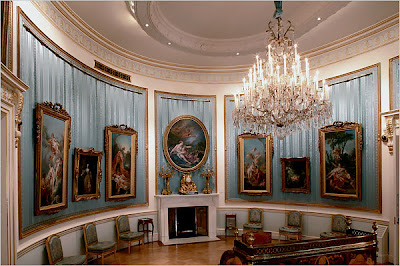
Some of the rooms which house the collection:


...I love walls upholstered with watered silk...

. . . . . .


Below: The Oval Drawing Room

For further information and a catalogue of the collection visit the official website here
Related Posts Plugin for WordPress, Blogger...